Thursday, 31 January 2013

Launch Event: JVC Reference Series 3D Projectors

JVC Kenwood Malaysia Sdn. Bhd has recently launched their latest state of the art 3D home cinema projector line. The event was held at AV Designs in Rohas Perkasa on 22nd January 2013. The members of local press and hifi blog scene fill up the venue, anticipating for something captivating from this new JVC line up.
The event was graced by their Managing Director, Mr. Takahide Sakamoto who gave a keynote address at the beginning of the event. He claims that this new lineup is a big step up from their existing e-shift technology (now known as e-shift2). Combined with the improved Multiple Pixel Control, JVC Upscaling and Enhancement technology, consumers will experience full HD images reproduction with maximum definition and also convert them to even higher quality 4K-resolution images. The upscaling will work with any sources like BluRay, DVD and even Astro B.yond.

 Together with the Sales and Marketing Manager, Mr. Steven Woo, 4 new 3D projectors were launched in Malaysia under the Reference Series. The models are DLA-RS66, DLA-RS56, DLA-RS48 and DLA-RS46. With the exception of DLA-RS46, all of the projectors offer High Definition 4K-resolution (3840 x 2160). The DLA-RS66 and RS56 also carries the THX 3D Display and Imaging Science Foundation (ISF) certification badges.

One of the big challenge of the 3D market for projectors and TVs is fatigue experienced by consumers for prolong viewing. With a new 3D circuit in the projector topography and newly designed RF glasses, JVC hopes consumers will have more stress free viewing experience.  Attendees get to experience with two different home theater set ups in the venue. The DLA-RS48 was set up in a smaller-home-like room, projecting onto a circa 105” screen. Using a Disney PIXAR 3D animation movie clips, attendees get to differentiate between ‘standard full HD’ and the 4K upscale.
There are five different 4K profiles to choose from depending on the source being played.
·         Film                        : Suitable for BD, taken and recorded by film originally
·         High Resolution     : Suitable for BD content, taken in 4K
·         HD                          : Suitable for BD content from a few years ago and Astro B.yond (1080i or 720p)
·         SD                           : Suitable for DVD (480p)
·         Dynamic                  : Any content
·         Consumers will also have the option of turning off the 4K upscaling mode.  
The group then moved to AV Design state of the art home theatre set up in a bigger demo room where it features the JVC flagship projector DLA-RS66 with the highest contrast ratio available in the market (130,000:1).  With a much bigger screen, this new projector is able to impress the audience further with captivating and seamless 3D projection of Avatar movie. The 4K upscaling enhancement is even more revealing from this flagship unit.
 This new line up of JVC Reference Series is definitely a must have for home theatre enthusiasts. Well, at least a demo session. You owe it to yourself!
The Reference Series is now available for purchase from AV Design.

Wednesday, 16 January 2013

Musical Fidelity First IEM - The EB50


This is MF first attempt in IEM devices and so far, a month usage of it shows how Anthony Michaelson hifi philosophy have been applied in the design.
I got to know about MF plans of producing earphones and headphones sometime in July 2012 in which I saw a few pictures of the prototypes of the designs. There were 3 headphones and 1 IEM.  The highest grade headphones was in nice brown leather.

Anyway,  MF then decided to delay the headphones production till end of Q1 this year (thats what I have been told) but they released their EB50 IEM in Oct 2012. I got a pair sometime in mid Nov.

So after about 1.5 months of usage, I must say that MF have hit the certain right notes on the design.

Specifications

  • Sensitivity: 100dB SPL/mW (1kHz)
  • Impedance: 26 Ohms ±15%
  • Max input power: 11mW (rated power 5mW)
  • Frequency range: 10Hz-20kHz
  • Distortion: <1%
  • Noise Isolation: better than 96%
  • Driver: 6mm balanced armature
  • Weight: 28g
  • Cable length: 1.2M
  • 3.5mm Gold plated Stereo jack plug
  • Microphone and answer button included


Built

MF claims that the design on this IEM was based their own internal deisgn and not a copy from other IEM manufacturer. To achieve this, they went back to the drawing board and create a product from the ground up, utilising new technology along the way.

I particularly like the thin and lightweight cables that they use, eliminating the 'fatigue' of having heavy cables hanging from your ears. The earpiece itself is designed such that its interchangeable between left and right ears usage. There is no specific designation on which side is left and which side is right apart the different colour of 'screws' on them. One side comes with red colours ''screws' and the other side is in blue.

They also use military-grade aluminium for the outer casing, which offers a strong yet anti-resonance body that is the ideal mounting for the capsule. (Wow.... a bit far fetch I suppose but I guess it will help to prolong the life of this IEM)

The cable also comes with iPhone friendly mic which delievers crispy clear phone conversation. I tried it with iPhone 5 and 4S and it work perfectly on both.

It also comes with a cable strap to manage the cable during storage in its pouch or in your pocket.

Flexibility

For perfect sealing within the ear canal, seven pairs of ear tips are included for personal preference. Also included are fittings for a tighter fit to the ear as well as a carry pouch for safe transportation.

I find the following tip best suits me. 


Sound

It can easily be driven directly from any portable players or laptops. As IEM is more for portability, I mainly tested it with my iPhone 5 and 4S. I repeatedly listen to Hotel California by The Eagle (Live version) and also recently I was hit by a preference towards Hindi songs (weird? Not quite due to the percussion behind hindi songs and also the shrieking high frequency of some of their female singers)... So I also played Chori Chori Hum Gori Se and  Bole Chudiyan.

Hotel California presentation overall presentation was bit flat to my liking, especially for a live version of this song. The vocal was a bit on the harsh side but not painful to hear as the bass from this IEM balances the high freq shortcomings.  Separation of musical instrument however is what I like best about this IEM. There some 'hidden' percussion beats that I did not hear on my previous Shure IEM.

Bole Chudiyan on the other hand did not come out to be as 'shrieking' as I thought it would. For those who are not familiar with this song, the female singer high pitch voice can be a bit deafening if played on the wrong hifi system or IEM. but with this IEM, (I guess due to the design emphasizing on bass), it overshadows the shrieking effect of this female voice. It was well balanced which made me really enjoy this song on this IEM.

Chori Chori then gave me a good exposure to what thie IEM can do when it comes to bass. It provides good solid and controlled bass. Even at higher volumes, no sign of stress on the IEM and also no sign excessive vibration or in laymen Malaysian terms - 'no pecah sound' :)

Vocal however does not sound lively. It does not give me the melodious feeling that I usually get from The Eagles and Hindi singers.

Conclusions

Its not an all rounder or balanced IEM. It does very good in the bass department with good control and detail and not overwhelming. Vocal is definitely not its strongest element where it can sound a bit flat. It does provide a more detailed sound wit regards to musical instrument compared to my Shure IEM.

IEM market is a tough one to breakthrough but I feel MF started off on the right track. For this particular EB50 model, it faces a tough challenge from other IEM brands especially in the likes of Sennheiser, Klipsch etc.

So, to me, it suits best for someone who is looking for warm bass sound and not particular with vocals.

It is priced at RM765 and the authorised dealer is LTB Enterprise.


Tuesday, 1 January 2013

Who Says Mini Disk (MD) is Dead?


I started off this new year by going through my MD collection and this particular album really strikes to me to be one of the best recording I have on MD. What a memory carrying the MD Net player with a few of my home made MDs on the way to university.

Playing through my Sony ES series MD player, and feed it through the MF M1 DAC, it can easily challenge CD reproduction.

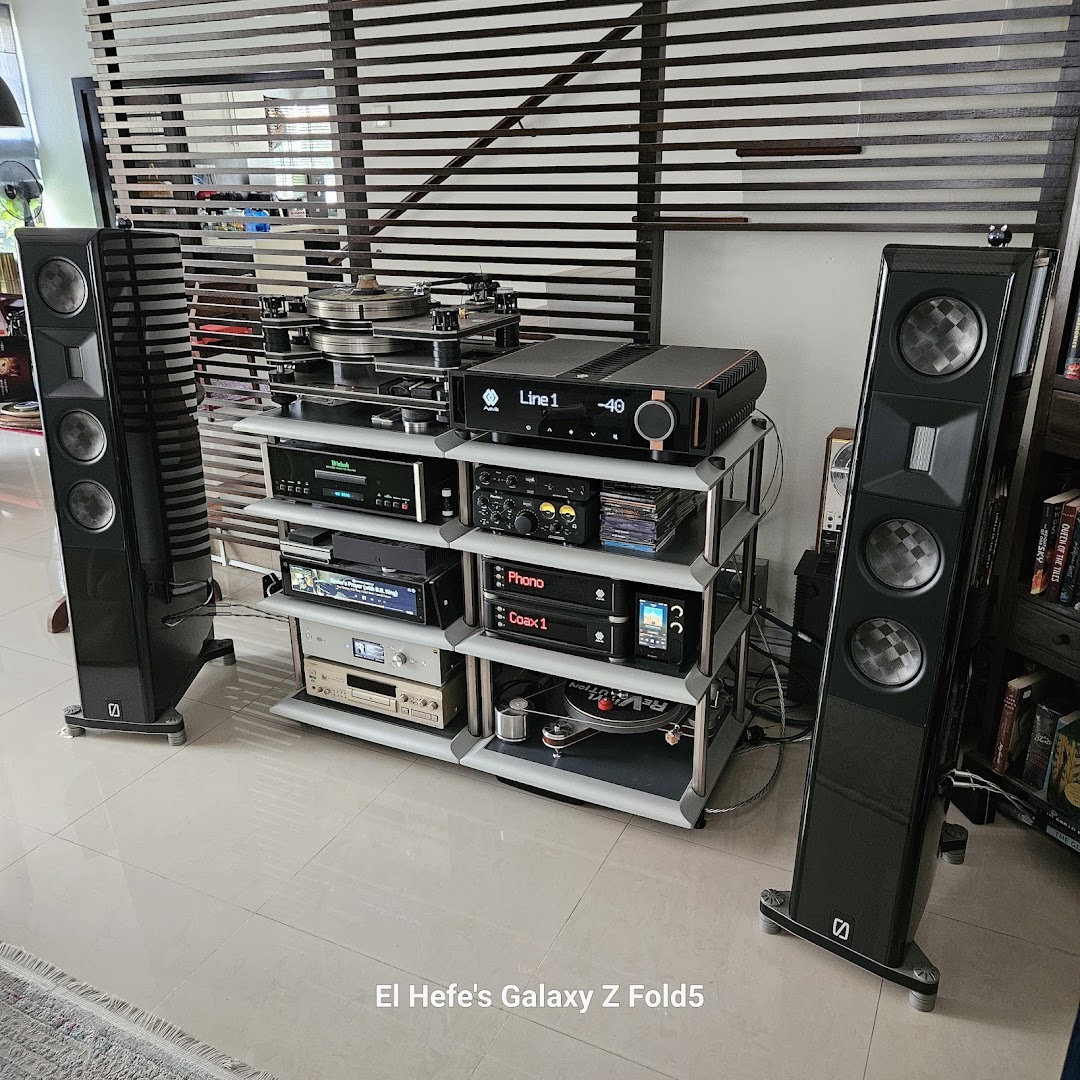
El Hefe's 2013 Hi Fi Set Up


This is what I have started off for 2013:

Home:
1. CD Player (Transport): Musical Fidelity CDT
2. Main DAC: Musical Fidelity M1 DAC
3. Streamer/2nd DAC: Musical Fidelity CLiC
4. Phono stage: Musical Fidelity M1 ViNL
5. MD Player: Sony MD JA20ES
6. Integrated amp: Musical Fidelity M6i
7. Power amp: Musical Fidelity M1 PWR
8. Headphone amp: Bryston BHA-1
9. Headphone: Alessandro Grado MS Pro
10. Tape deck: Onkyo TA2600
11. Turntable: Clearaudio Concept
12. Speakers: ProAc Response D18
13. Power Management: Belkin PF50

Notes:

Siltech cabling for items 1, 2, 3, 6, 7, 12
QED cabling for items 4, 5, 8, 10

2013 targets:
1. New Main DAC: either Musical Fidelity M6 or Bryston BDA-2
2. Record Cleaning Machine

Office:
1. Source: iTunes and WMP
2. DAC: UD100 ESS Sabre USB DAC
3. Speakers: BOSE Companion IIs
4. Headphone amp: Musical Fidelity M1 HPA
5. Headphone: BOSE Over the Ear

Note:
QED Cabling for items 2, 3, 4

2013 targets:
1. Musical Fidelity first headphones....

Tuesday, 25 December 2012

Kingrex UNANIMOUS U-Art (Y) USB cable


UNANIMOUS U-Art (Y) USB Cable: The Art of Separation
First impressions: Impressive! When I received the sample, it was immaculately packaged in high quality box, complete with foam to house this cryogenically treated USB cable. The red woven USB cable does look the business and Kingrex spared no expense in its built too. With 24K gold plated USB A and B connections and cryogenic treatment on its silver-plated oxygen-free copper conductors, this cable made me intrigued to really test whether it will deliver more over my current el cheapo USB cable. Each and every piece of this cable is also 100% handmade.

The first unique feature I noticed is that this USB cable came in with 2 of USB A connector; Y-split from one USB B connector. This is where Kingrex is proud of its design of separating power signal from digital signal. These USB A connectors are labelled with ‘Battery’ and ‘Wave’ signal diagrams. With the USB B connector plugged into Kingrex UD384 USB DAC or any other USB enabled DAC, there are 2 ways to connect the A connectors:

1.      Connect both Battery and Wave connectors into 2 separate USB inputs on your laptop
2.      Connect the Wave connector to your laptop and Battery connector to Kingrex U Power battery supply (featured in previous review of UD384 USB DAC)

I opted for option 2 above for this review. It gets a little bit untidy when you need to connect one USB A connection to a power supply e.g.: the U Power then the other to the laptop. It’s like a 3 way junction on my hifi rack. Even though, you can actually connect both USB A connections to the laptop, but with U power is when the cable perform best.

Straight out of the box, the sound produced through this USB cable is as ‘cold’ as the cryogenic treatment itself. A bit on the flat side. Although, spaciousness is something that’s immediately noticeable.

Specs:

·         USB 2.0 high speed certified
·         Transmits data up to 480 MBPS
·         Separate power and signal cable
·         Length: 2 metres
·         Flat structure
·         4 signal Conductor SymmetricTM

Performance:

To me, testing cables is trickier compared to hifi equipment. Most times, the different in SQ can be so subtle that our ears just cannot hear what different cable can do to the music we listen to. And for this, I only used 1 particular track: Black Magic Women by Santana (MP3 320 kbps/48 kHz). I chose a hi spec MP3 as oppose to a FLAC to really test what this cable can do to a less superior audio format.

The percussion on this track is one of my favorite. Its not a typical heart-pounding drum beats but more musical and ‘traditional’ so to say. Just to refresh my memory on how the sound is, I played this track using my el cheapo USB cable. Immediately after that, I swap it to this U-Art cable and boy how the sound changed. Notice here I mentioned the word changed rather than improved. The sense of space suddenly filled my room. The liveliness (or is it hippiness?) of Santana music coloured with spaciousness where the extension of the low ends was beyond the normal experience I have with this track. It was still controlled but it somehow sounded like each notes were extended. However, even though spaciousness is there, it still sounded a bit flat.

I was then advised by Kingrex to run in the cable for 300 hours and that’s what exactly what I did.  Throughout the run in period, I listened to various songs just to be more critical on this product. I didn’t actually time myself to reach 300 hours but after about 3 weeks of listening, I played the Black Magic Women track again. Now, this is something completely different compared to the first time around. The spaciousness is even more evident plus the flatness was gone. Santana’s guitar sounded so melodic and the stereo imaging and staging was perfect. It made me visualized where each musician were standing or sitting during recording. The percussion in this song was awe inspiring enough that made me jump out of my chair and started playing along to the song on my drums.
Final verdict: The Unanimous U-Art Y USB cable is definitely one cable that serious CAS enthusiasts should audition even though if it is to connect to their own DAC. At a retail price of USD599, this cable compliments nicely into a basic to even high end CAS set up. It’s a no frill and no nonsense upgrade with little risk of you not be able to hear the difference it can make to your system. If your CAS system sounds flat and in need of some breath, this is one cable you should try to audition.

Signal and power separation really made the different. And of course the cryogenic treatment definitely played its part too. Its well built and deliver or now I can say improved my CAS set up over the el cheapo USB cable. If spaciousness and liveliness of music is what you are looking for, this cable excels in that.

Gear:
a.       Hardware: Macbook Pro
b.      Software: iTunes for 320 kbps/48 kHz MP3s
c.       Amplifier: Musical Fidelity M6i + M1 PWR power amp
d.      Speakers: ProAc Response D18
e.       Speaker cable: Siltech Classic Anniversary 330L
f.       Interconnect (UD 384 RCA to M6i amp): Cambridge Audio 700 Series

Price: UNANIMOUS U-Art (Y) USB cable is retailed at USD 599

To contact Kingrex directly, they can be contacted at:

Carol Tseng                     
Tel: +886-2-8226-9561
Email: carol@jt-comatz.com or service@kingrex.com


Wednesday, 7 November 2012

Kingrex UD384 USB DAC and U Power

A long awaited review but I had to take more time on this unit due to its dual functionality.

When I was first contacted by Kingrex via email, I thought it was a friend of mine playing a prank on me. But when I looked at their website, I decided to reply their email and 3 weeks later, I received the UD384 USB DAC and its matching U Power battery based PSU.

So what is this UD 384? Its actually a 2 in 1 USB DAC and SPDIF convertor. The latter is meant for those with DAC that does not have a USB input. Similar function to Musical Fidelity V-Link and M2Tech SPDIF convertor.

The U Power is basically a PSU which comes with a built in rechargeable battery. It is claimed that it will then supply a more stable power to the UD384 DAC compared to the plug that came with the UD 384 DAC.

Built

Both unit are of the same size, makes it a good match. Its lightweight it fits easily in the palm. Given the size, it is actually quite a sturdy unit. I believe some basic engineering design was put in for the casing as it has sufficient weight plus 4 small rubber 'pads' installed underneath the units; to withstand movement when you placed it on the table. Even with my stiff Cambridge Audio interconnect, the unit did not move when I connect it to my set up/Bose speakers. The casing is made of aluminum with black hairbrush polish.

The 2 units can be stacked together making it look like a matching pair. It measures 88 x 82 x 24 mm.

The UD384 comes with a 3 pins UK ‘walmart’ power supply, A-B USB Cable and a thumbdrive which has the required driver for Windows, plus some music samples (well at least for the unit I received). Readers may be familiar with my particular dislike against those 7.5V power supply plugs but thats just me. The yellow power indicator LED is also very soft to the eyes.

The U Power comes with the same 3 pin UK power supply to recharge the battery, another power supply cable to connect from U Power to the UD 384 and a product manual. It has a switch to choose between supplying power to the UD 384 DAC or to recharge the battery. The green power indicator LED is also very soft to the eyes.


Connectivity

UD 384:

Input: 1 x Asynchronous USB B input

Outputs: 1 x pair of gold plated stereo RCA, 1 x SPDIF coaxial

U Power:

Input: NIL

Output: NIL (just 7.5 V out to the UD384 DAC)

Specification

The UD384 can direct stream from PC or Mac at 16 bit/44.1KHz to 32 bit/384KHz through analog output –RCA & digital S/PDIF output. The UD384 is running in asynchronous mode for best performance. The master clock generator is a classy 1ppm TXCO unit with proprietary low-jitter drivers for Windows & Mac. Direct Sound, ASIO4ALL, and WASAPI are all supported and run smoothly.

For the RCA output, it can handle sampling rates of 44.1 KHz, 48 KHz, 88.2 KHz, 96 KHz, 176.4 KHz, 192 KHz, 352.8Khz and 384Khz and bit rates of 16, 24 and 32.

Unfortunately, for the SPDIF output, it can only handle sampling rates of 44.1 KHz, 48 KHz, 88.2 KHz, 96 KHz, 176.4 KHz and 192 KHz and bit rates of 16 and 24 bit 2 Channel. For this particular section, I can confirm that as I connected the SPDIF output to my Musical Fidelity M1 DAC which can show the input signal.

Both of the outputs here can be used simultaneously. So, you can connect to a headphone amp and a DAC simultaneously, for example.

Setting Up
Connecting to my Mac and Macbook Pro was easy. Basically plug and play. No driver installation required (that’s why I am keen on Apple products!). Connect the UD384 via the supplied A-B USB cable and the Mac recognizes it and chooses this output automatically. No issues encountered using both iTunes/Bitperfect and also MPlayerX (for FLAC) on this unit.

Connecting to my Window Vista based Dell laptop was not quite straight forward. As opposed to my Naked USB DAC….., the UD 384 cannot be connected via my laptop docking station. My laptop just cannot detect the unit. Installation of the provided driver also could not be completed with an error message stating that there was a component missing. Kingrex have been informed of this issue. However, being an IT dummy, I just tried connecting the USB cable directly into my laptop instead of the docking station, and Voila, it detected the UD 384. Then the excitement started.

Another issue is that, as my laptop is about 10 ft away from my hifi set up, I had to use a long A-B USB cable (about 3 m in length). This is my usual set up when I connect my laptop to MF M1 DAC. However, using a long USB cable with the UD 384, it created a loud continuous clicking sound through my hifi set up via the SPDIF. Hence, for this review, I had to set up my laptop near enough to my hifi set up.

There are some settings need to be changed on the laptop sound output which are clearly explained in the UD 384 manual with a snapshot of the laptop instruction step by step.

Review Set Up

1. For the office use:

a. Hardware: Window Vista Dell laptop

b. Software: Window Media player for FLAC, iTunes for 320 kbps/48 kHz MP3s and WAV files

c. Speakers: Bose Companion II

d. Interconnect (UD 384 RCA to Bose speakers): Cambridge Audio 700 Series

e. Comparison: UD100 DIY ‘Naked’ DAC

2. For home use:

a. Hardware: Macbook Pro

b. Software: iTunes for 320 kbps/48 kHz MP3s and WAV files, MPlayerX for FLAC

c. Amplifier: Musical Fidelity M6i + M1 PWR power amp

d. Interconnect (UD 384 RCA to M6i amp): Cambridge Audio 700 Series

e. Interconnect (UD 384 SPDIF to M1 DAC): Cambridge Audio 500 Series Coaxial

f. Comparison: Musical Fidelity M1 CLiC streaming from WD NAS


g. Siltech Classic Anniversary 330L speaker cable
3. For both set ups, I opted to use the U Power to run the UD 384. Hence, I am not reviewing the benefits of using U Power as oppose to plugging the UD 384 to a wall plug.


The Test Tracks

1. Siboh Kitak Nangis – Zee Avi (MP3 320 kbps/48 kHz)

2. My Hero – Foo Fighters (MP3 320 kbps/48 kHz)

3. Hotel California – The Eagles (24 bit/192 kHz FLAC)

4. Enter Sandman – Metallica (24 bit/96 kHz FLAC)

5. Time To Say Goodbye (Live in NY) – Andrea Bocelli (24 bit/48 kHz FLAC)

6. Kingrex supplied tracks with various bits and sampling rates up to 384 kHz

The Office Session

The first time I connected the UD 384, I played Siboh Kitak Nangis by Zee Avi because this was the track that mesmerized me when I reviewed the Naked DIY USB DAC. Straight out of the box, the UD 384 sounded a bit harsh but the sound staging was really evident. Direct A/B comparison (by switching the sound output between UD384 and naked DAC), the UD 384 excel with sound staging. With the track already gave me an emotional experience during the Naked DAC review a few months back, I experienced the same emotional session but with more liveliness and involvement to the music. The vocal was much upfront and the music created a backdrop that made me able to visualize how the song was recorded in the studio. It was indeed a step up to the Naked DAC. But it does cost about 18 times more than the Naked DAC so its not really a fair comparison!

Playing My Hero by the Foo Fighters also gave me a similar experience in sound staging. Its almost made me think that I was listening to a live recording rather than a studio recording. The overall music sounded uplifted with a airy atmosphere. Nevertheless, the thumping of the overlapped drumming by Taylow Hawkins is still heart-pounding and Grohl’s guitar riffs are rocking as ever.

Changing to FLAC files, especially Hotel California and Time to Say Goodbye, the UD384 provided accuracy, boldness and almost balanced presentation between the highs and the lows. The vocals from Andrea was with full emotion and it can be translated into what I call a true satisfying and uplifting atmosphere in my office. However, there was still some harshness in the highs.

The harshness was so evident. The Naked DAC might have lost in the sound staging but still win with overall presentation. Hence, since Kingrex is giving me ample time to review this item, I decided to take up on the suggestion by the manual that this unit needs 200 hrs of running in. So, before I moved on to connect this item to my home hifi set up, I let it run for 200 hours in my office.

The Home Session

I first loaded all the above tracks onto both my Macbook Pro and WD NAS to do a direct A-B comparison between different DACs to process the tracks. Technically, with the above mentioned set up, I am doing comparison between 3 DACs:

1. UD 384 itself

2. MF M1 DAC where the UD384 SPDIF convertor feeds the signal to M1 DAC

3. DAC in the MF CLiC

However, for sake of simplicity, the SQ comparison is only done against the CLiC. The M1 DAC is just to confirm the functionality of the UD 384 ie: can it feed the raw and unprocessed hi res files to the DAC?

So, firstly for this, I have used all the tracks supplied by Kingrex which ranges from 44, 48, 96, 192 and 384 kHz sampling rates and played it on my Macbook Pro, feeding it to the M1 DAC. And I can confirm that the UD384 can feed raw and unprocessed signal to an external DAC. AS you can see from the picture below, the M1 DAC shows the incoming signal sampling rate. However, for I could not test the 384kHz files as the M1 DAC can only receive maximum 192 kHz. Therefore, this unit is very useful for people whom wants to get into CAS but does not have a DAC with a USB input, if one still prefers to use their existing DAC.


Now that the technical part is done, its music time. First up was Zee Avi’s Siboh Kitak Nangis. The UD384 delivers an astonishing clarity and soundstaging after 200 hours of burning in. I just cant believe that this small unit can produce such a big sound. The boldness of the ukulele strum was very evident and just blends in with her voice at a different level compared to using this unit with my office Bose speakers. The natural sound of her voice was represented by a clean and transparent soundstaging. It was indeed a very satisfying experience.

I skipped My Hero and went straight to FLAC with Metallica. Now this is where it became a very different experience. The drums and guitar riffs became very digital sounding in which it became virtual sounding It may be the quality of the file itself but playing the same file through the CLiC, it sounded more natural and bold with drums sounds very convincing and makes me feel involve and just jump on my drums to play along.

Andrea Bocelli’s track was of course the ultimate challenge for me. And the UD384 delivered what I say would be a close match with the CLiC. The UD 384 provided me with the sound staging of a live performance but somehow lacking in the tonal balance. The usual balanced highs and lows that I get from this track is somehow lacking. But nevertheless, it is actually close enough with just a few moments of the track that the UD384 looses out a bit.

The Verdict

The UD384 (and the U Power for that fact) is a next generation, no nonsense upgrade for any CAS enthusiast that can splurge more than my Naked UD100 USB DAC. It is also a unit that can provide a 2 in 1 function plus it can easily match a sub RM2000/GBP400 full deck DAC. And it excels in delivering a soundstaging that can really make you feel involve with the music. I do recommend this for people who are into hi res music because that is where you can rip the full benefit from this unit. Retails at GBP 365/Euro 399, it is a little bit on the pricey side as it can only offer one input which is the USB. And with the limited source of 384 kHz music, one can get a full deck with multiple input for the same price. But as I mentioned, if you are really serious in hi res, you will reap the sonic benefit of this unit.

For the Malaysia market, the nearest point to get a hold of this unit is in Singapore. However, Kingrex welcomes if you would like to contact them directly.

Carol Tseng

Overseas Sales Representative
KingRex Technology Co., LTD
ADD:13F-3, NO. 136
MING-CHUAN W. RD
103 TAIPEI TAIWAN
Tel:
+886-2-8226-9561

Fax:+886-2-8226-2626

website: www.kingrex.com
www.kingrex.net

Monday, 29 October 2012

Saturday, 13 October 2012

Bryston BHA-1 Balanced Headphone Amplifier


Hi all,

I finally received and hooked up this wonderful piece of kit 2 days ago and this is my first 24 hours review.

First of all, why the change from Musical Fidelity M1 HPA headphone amp?


I blame it on the Kuala Lumpur International AV show held in July this year. For this year event, I didnt have anything in mind to purchase. Just attended the show to look around and support a few fellow hifi friends who was show casing their set up. However, it was written in the star that I was to catch a glimpse of this unit on demo from the local supplier. I have several times listened to Bryston set up several times and it has its own merit. But when I saw this headphone amp, I said to myself, I have to try it, especially that it was paired with Grado PS1000 Smile

My my my....it was a jaw dropping experience. As soon as I put on the cans, I was instantly disconnected from the busy surrounding and my mind just focussed on how this unit can deliver such a lively, detailed and natural sound. Such beautiful presentation. But, is it the amp or PS1000 giving me this experience. So, I told myself, I have to try it with my Alessandro Grado MS Pro. Unfortunately, I can only attend 1 day of this 3 days event. So, I guess I have to pay the dealer a visit after the show. And only this week in Oct I have the time to do it Smile

I went to the dealer's shop (AV Designs) with a good hifi buddy of mine from Indonesia. The shop is actually in the same office building as mine and requested a demo on this unit again.

Both James and Low were there and they were very accommodating despite I didnt arrange for an appointment first. I was there for 2 reasons actually. One is to demo this amp again. And the other is to check out their sale on various items. I can see at one corner number of boxes of AV amps, BD players and speakers ready to find a new home at a much discounted price. And I have to admit that I did not leave this shop just with this Bryston amp. The sale on the items was just too good to be passed.

James and Low initially explained a bit on the unit as I had questions on those multiple headphone outputs. Frankly speaking, I never knew there were balanced headphones.

However, just to reconfirm the experience I had in the show, I tested it with the PS1000 cans first. Sure enough, I was not dreaming during the AV show. In fact, it sounded even more natural this time. After discussing with them on some technical queries and commercial of course Smile...I told them that I would need to test the amp with my cans. They fully agree and did not hesitate to invite us to their shop the next day. So, I popped in again the next day with my Alessandro Grado. Part of me hoping that it will not sound as good with my cans to avoid me parting with about RM X380 and ditch my MF M1 HPA. And.... I lost the battle and succumbed to luscious Bryston Smile. It still delivered such a lively and non-exhaustive listening session. And now the unit is hooked up to my system.

Built

This unit is built like a tank, a typical Bryston feature. I opted for the all black unit to match the rest of my black MF set up. The dimension L x W x H is 17 x 11 x 2.425 and weighs 5.3 kg. The volume and balance knobs are sturdily fitted and has the right amount of friction to gradually increase the volume in a smaller scale. Thw power, input and gain switch however are of an old school electrical switch which I dont particularly fond of but the MF M1 HPA uses the same switch too. On the rear, the RCA connection is of gold plated. The power supply connection is IEC and comes with a basic power cord with a UK 3 pin plug. The front fascia is a mix of modern and vintage look and for some might even say it looks a bit industrial. The blue LED power indicator is also soft to the eyes.

Its a Class A amp but does not run really hot. In fact, my Class A/B M6i runs hotter.


Inputs and Outputs

There are 3 inputs available:

1. Single ended RCA

2. 3.5 mm stereo jack

3. XLR Balanced

The unit can drive 3 headphones at one time but with different output connection:

1. 1/4 stereo jack

2. Stereo Balanced output (4 pin XLR)

3. 3 pin Balanced Output

NOTE: there is also high and low gain switch to match your headphones.

I am limited to use the RCA input and 1/4 stereo output.

The Set Up

I hooked up the unit via the tape loop on my MF M6i integrated amp using QED RCA Signature series IC and QED Qonduit power cable.

Sources are:

1. MF CDT via M1 DAC with Siltech XLR cabling throughout

2. MF M1 CLiC with Siltech IC

3. Clearaudio Concept TT via MF M1 ViNL

Gain was set to low.

Headphones are:

1. Alessandro Grado MS Pro

2. B&O P5 (courtesy of my Indonesian buddy)

The Tracks

1. Girl from Ipanema (Stan Getz/Gilberto) - FLAC

2. My Hero (Foo Fighters) - MP3 48kHz 320 kbps

3. Time to Say Goodbye (Andrea Bocelli) - CD

4. Hotel California (The Eagles) - FLAC

Out of the Box Performance

I was so excited with the purchase that I put aside the ‘run in’ principle. Hooked it up and immediately put on the cans and fired up Foo Fighters. Even out of the box, this amp delivered a very powerful yet subtle bass from the drummings on this track. Very detailed presentation in which the 'overlapping' drum beats can be heard on each note. After listening to this track, I went out for dinner and let it run in for 3 hours. In fact, the dealer did mention to me I can actually enjoy the high SQ even fresh out of the box.

The Listening Session

After 4 hours of running in, I started to run my playlist above. First up was Girl from Ipanema. The vocals on this track was somehow elevated and created a personal space to me. ONce the music came, it gave me a different experience compared to playing Foo Fighters. A very relaxing sensation kicked in due to ambience delivered by this unit. However, maybe because its FLAC file, the volume seems a bit lower compared to playing Foo Fighters. I tried switching the gain to high. It did increase the volume level up a notch but I loose the subtlety that I was enjoying. So I wswitched back to low and increase the volume to about 10 o' clock. Previously it was at 9 o' clock. With power output rated at 1 W into 32 ohm, it can easily drive my cans.

Next up was Andrea Bocelli and Sarah Brightman. This track has always been one of my favourite track for reviewing as I measure the performace of the unit tested against Andrea's and Sarah's vocals. Both of their vocals compliment each other to have a balanced tone (high and low pitch). And sure enough the Bryston delivered this flawlessly. This was one part of where the MF M1 HPA having difficulty to deliver the balance for this track.

I then went back to a FLAC file Hotel California. Listening to slow rock and in this live performance by the Eagles is even much more soothing. The live ambience was delivered by the Bryston through my cans that made me feel that I was at the concert and audience are supplied with a personalised headphones. The drums and guitars on this track was so refine and detailed out that you can here every single strumming and plucking the Eagles. This was one track that I repeated thrice just because it sounded too good to be true that I had to confirm and reconfirm the statement I made above. And each time, the Bryston just keep presenting a lively experience.

I went through all the tracks again using the P5 headphones. Unfortunately, the pair didnt give me the same satisfaction. This made me further believe that just like speakers needs to match the amp, headphones are the same. I am not saying the P5 are not good headphones but it just didnt rhyme nicely with the Bryston. A bit on the harsh side.


So there you go. A solid performer this amp is.

Is it worth the price? I strongly believe so.

Will I let go of my MF M1 HPA? Not so soon. It will do some office duties first.

Will I recommend this amp for head-fi-ers? Definitely with a word of caution. Demo it before purchase with your own cans.

But now I am curious how would a balanced headphone sounds like????? Will there be another quest for a new pair of cans after the Alessandro?

Wednesday, 18 July 2012

The 'Naked' UD100 USB DAC


The ‘Naked’ USB DAC


I was in the market recently to purchase a small, portable USB DAC. Mainly to have a quick upgrade to office set up. Set up here is simply a laptop running iTunes/JRiver connected via 3.5 mm x RCA to a pair of powered Bose Companion II speakers. I did wanted to listen to ARCAM rPAC but have yet the chance to visit the distributor. And when our fellow forummer in the DIY section offered openly to anyone whom would want to review his DIY DAC, I solemnly offered my time to him to do a review.

First of all, a big thank you to hifi4sale.net team for having a platform for hifi enthusiasts to share their interest with others. Secondly, thank you to chchyong89 for having the courage to share your DIY design for review.


The Topography

From the picture above, you know why I call this unit a ‘Naked’ USB DAC. Its physically a clean and bare piece of USB DAC. Main components being the USB, the DAC and the 3.5 mm jack.

The DAC used here is an ES9023 Sabre DAC. Its commercially available and it’s basically a 24 bit stereo audio DAC with an integrated 2Vrms op-amp driver. For more information on the ESS website http://www.esstech.com/PDF/ES9023%20PB%20Rev%200.2aPB%20110117.pdf

It is also a synchronous USB unit. A simple definition:

Synchronous USB connections use a one way digital connection for music replay and are considered the worst type of connection for audio purposes

Asynchronous mode is technically most advanced in that it has a feedback loop so that the amount of data in the frame can be controlled.


It is also a plug and play device which works on both Windows and Mac. No software to install. Just plug in and the computer will detect the USB DAC. It will also be the default audio output for your computer. Need to deactivate it if you want to listen to music through computer speakers.


The Listening Session

Three set up were used for the review.

1. My home set up using Window base laptop, running iTunes/jRiver. The USB DAC was then connected to my MF M6i amp using QED 3.5 mm to RCA interconnect. Played through ProAc D18 speakers.

2. My office set up using the same laptop. The USB DAC was connected using the same interconnect connected to a pair of powered Bose Companion 2 speakers. (NOTE: This is actually the main set up that I intend to find a USB DAC for)

3. Using same laptop and the USB DAC is connected directly to my Shure and Sennheiser IEM.

The same tracks were used in all 3 set up:

1. La Mer – Kevin Kline (MP3 48kHz, 320 kbps)

2. La Mer - Charles Trennet (MP3 48kHz, 320 kbps)

3. Siboh Kitak Nangis – Zee Avi (MP3 48kHz, 320 kbps)

4. Enter Sandman – Metallica (FLAC)

5. Time to Say goodbye – Andrea Bocelli (FLAC)

6. Hotel California (LIVE)– The Eagles (FLAC)

Now, don’t be fooled by the miniature size as the result from this DIY unit can be summarized in:

One word – Ingenious

Three words – Size Doesn't Matter

Many many words – One of the best sounding, effective and fuss free upgrade for CAS.

Using Setup 1 at home, there is gap in overall presentation compared to playing my music collection from the NAS via the MF CLiC. Playing La Mer by both artists above via the USB DAC was actually enjoyable. However, it is sort of being amplified as the hiss on the old and original recording by Charles Trenet was more evident then playing it through CLiC. But for more modern recording, there was a slight loss in the details of instruments played on the tracks especially Hotel California. Nothing to fuss about but the Naked DAC presentation loss a little bit of life in the Live ambience of that track. It may also be that for the Naked DAC, I was using the QED interconnect as oppose to Siltech on the CLiC.

When I switch to Enter Sandman, it was hard to spot any difference compared to playing it on CLiC. The Naked DAC gave a similar rock thumping bass drum and the guitar riffs were as metal as it can be.

The most evident however was with Siboh Kitak Nangis. This is a simple and wonderful track by local Miri lass who shot fame in USA by the name of Zee Avi. It is in a local language. It’s a mixture of Norah Jones with a touch of Hawaian music. The Naked DAC injected a new life and experience listening to this track. It gave so much and openness that it made me feel that Zee Avi was performing life in my room.

Now, listening through Shure andSennheiser IEM, in contrary of the designer’s statement in his thread that it is advisable to connect the Naked DAC to a headphone amp, it drove my IEMs nicely. No sound of stress and definitely provided enough clarity and sound level for listeners to enjoy their music without the fuss of a headphone amp.

The last review is meant for the very reason I wanted to get a USB DAC which is to ‘upgrade’ the sound quality in my office. My setup in the office is nothing to shout about. I just connect a pair Bose Companion SII speakers to my laptop.


I know most audiophiles would not even look at a Bose products, but these speakers serve their purpose nicely in my office. But I just wanted to see whether a simple set up (laptop + speakers) can still benefit from a tweak. I don’t particularly like internal laptop tweaks on software nor hardware. I just prefer a plug and play approach. So this Naked DAC was a perfect bill for this purpose. And boy, my jaw literally dropped when I played Siboh Kitak Nangis through this USB DAC. For a simple set up like mine, the USB DAC gave this track a whole new experience to what they call ‘background’ music while you work. In the office I don’t particularly focus on the music as I just need it as a background music while working. But using this USB DAC, work was no longer a focus. I was basically drifted away listening to this track and another track and another track. It created this emotional space for me where I can feel the emotions that the singer was trying to deliver. Similar to the other tracks like La Mer and Time to Say Goodbye. Andrea’s vocals played through the USB DAC and the Bose speakers was so open and spacious that it felt like my whole office was fill with music. Not to mention another colleague of mine stepped in and went ‘Wow….Did you do something to your speakers?’ He too was very impressed that this small USB DAC managed to change the sound quality of simple set up.

The Verdict

Small but powerful, in short. The Naked DAC is definitely a very basic upgrade for CAS but the outcome feels like you have a fully spec’ed DAC box. The only different is its size. Its half the size of the normal thumbdrive.

I cannot say it is value for money as its currently not commercialised.

One recommendation is of course to come up with a proper casing. Then we can call it a Dressed Up USB DAC. The reason for this recommendation is because of its small size, people will tend to make it portable. Hence, it warrants some kind of protection on the exposed DAC chip.

Will the designer sell the unit? Will he mass produce it? Will he be the next Datuk like the father of pendrive Pua Khein Seng ?Smile I let him announce his own plan.

I just wish I had more than 1 week to play around with the DAC.