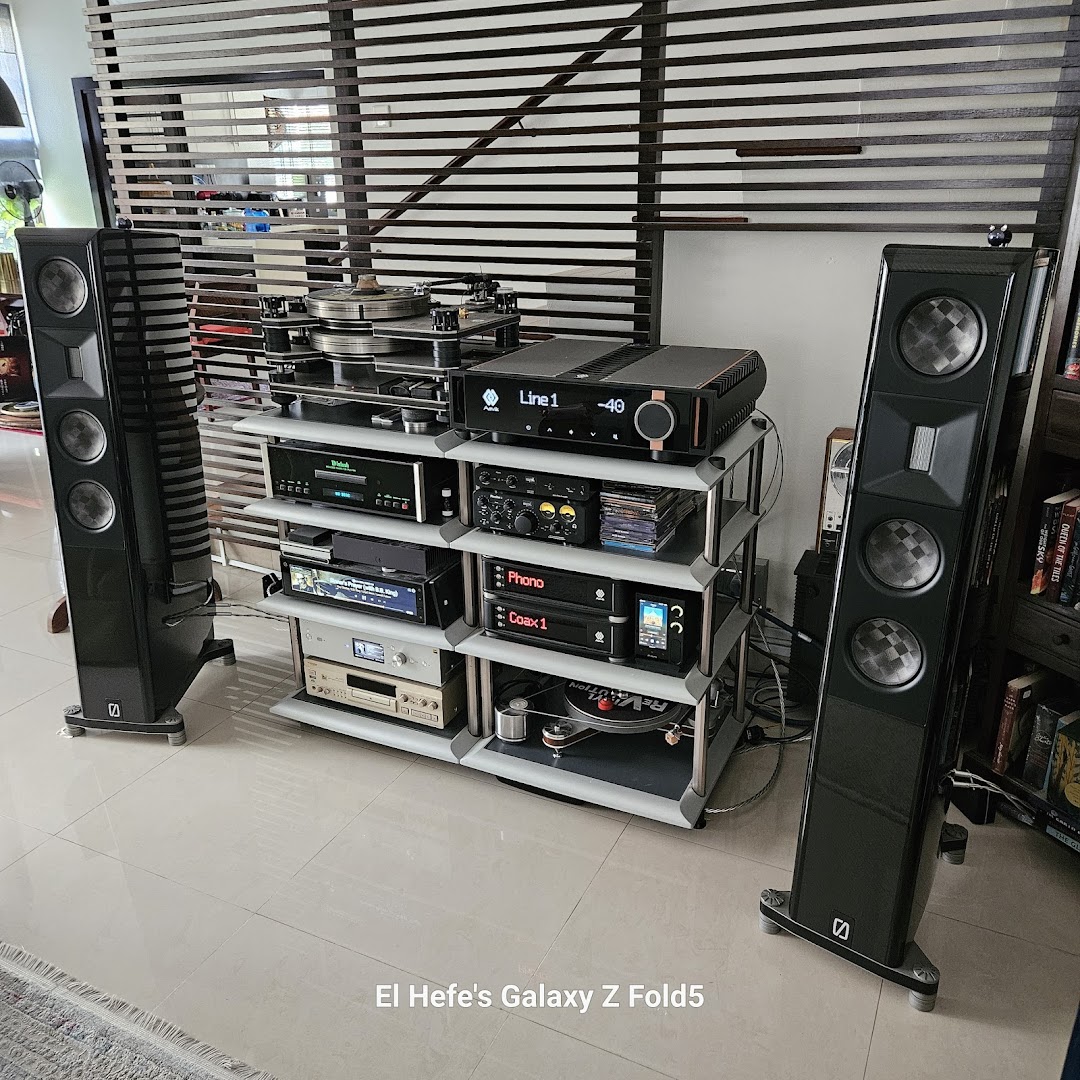
Its like the HiFi and AV industry in Malaysia is back into the good old days. More and more shops are bringing in more variety to the audiophiles. A long pending components to be open to the fans are the TAD R1TX speakers, M700S stereo power amp, DA10000TX DAC and also the full suite of Innuos Products. Although TAD has been traditionally part of Audio Visual Designs Sdn. Bhd list of brands, the Innuous has just came onto the list and is now officially available for demo and purchase for local fans.
On Friday 7th July, these products have been officially launched at their outlet. Attended by the usual audiophiles and other media reps, the full capability of the set up was demoed to all attendees.
Excerpt of the event report from my article in hifi4sale.net is as below:
'Audio Visual Designs Sdn Bhd (AV Designs), the official distributor of TAD Laboratory products in Malaysia, launched the R1TX flagship speakers along with the M700S power amp and DA1000TX DAC on July 7. Apart from these TAD products, AV Designs also launched the full suite of Innuos products into the Malaysian market. AV Designs only recently took up the Innuos distributorship.
The launch event started with a quick recap of the R1 speakers' evolution over the past 16 years, followed by an introduction to the Innuous products. Guests and media folks were then entertained with various music genres prepared and presented by local hi-fi celeb Joseph Ki.
The original R1 came out in 2007, followed by R1MK2 in 2012 when the woofer cone design was upgraded. The R1MK2 remain as TAD's reference speaker until 2019, after which the R1TX was officially launched. However, due to the pandemic that followed, the R1TX could only be brought into Malaysia this year.
Although the R1TX retains the original cabinet design, TAD has enhanced its forming and processing method for the baffle. This new cabinet is made by Tendo Mokko, where the reinforcement and fitting methods were improved; the side to back panel configuration was also changed from three pieces to two. Besides these, TAD also enhanced the woofer suspension system. The R1TX comes in a full black design, apart from the traditional wood design on the side panels.
The M700S was also launched in 2019 by TAD but only reach our shores early this year. This stereo power amplifier (a mono version is also available) replaces the M600 which was launched back in 2009. The enhancements include an upgraded transformer from 2kVA to 2.8kVA, increased wattage from 600W to 700W, aluminium chassis instead of iron and also a new spike construction.
On the source side, the full Innuos suite of streaming solutions is now available officially in Malaysia. During the launch, the flagship Statement model was used as the source for the demo of the TAD set up. The Statement is a two-piece dedicated streaming unit with a separate power supply box. This brand from Portugal is not new name to streaming fans in Malaysia. The full range, from the entry-level called PULSEmini to the Statement, is now available from AV Designs.'
AV Designs has also taken the liberty to list Bassacontinuo HiFi racks as one of the brands on their list.
When I lookd at the size of the speakers, I had a concern of an overwhelming bass response. I am not fond of bass that gives out literally a physical impacton my body. One of those too hard of hitting that it makes it uncomfortable to listen to. But not with these TAD R1TX. Excellent balance of low frequency response coupled with high clarity in the mids and highs. The bass drum and also the percussion sounded really enegrized going through this system. It really gets me going, bringing me back to my younger days of clubbing. Now, on another piece, the sound of saxophone was really melodious and engaging. It matches well with the Innuos source.
\
Sampler 1
Sampler 2
For a demo session, please contact AV Designs (03-6241 1237).
For as far as I can recall, the
digital domain in HiFi seems like a continuously fluid search for an end-state.
If it’s not the digital format, it’s the streaming format. On top of that is
the reproduction of the music via coding and decoding. I have always had a central DAC unit for my
various digital sources but in the past few years, I’ve settled on an all-in-one solution with the
HiFi ROSE RS150, McIntosh MCD350 and SONY HAP Z1ES. Maybe because I have too
many boxes on the rack :). I have been content with this new way of
listening..... until....
Having the The Discrete DAC by
MSB Technology for about a month reminded me on how having a separate DAC can
make a whole lot of difference.
Introduction
The unit is built around MSB
Technology Prime DAC modules which provide flexibility towards future formats
and upgrades. This module is unique to MSB as they are custom, in-house made
modules that can take on various formats in a fully balanced design. It goes up
to 6 MHz for PCM and 50 MHz for DSD.
Quoted from their website, the
key highlights of the Prime DAC modules are:
●Fully Balanced design down to the conversion point.
●No buffers, IV converter, or transistors in the signal
path. No active devices after conversion at all.
●Dynamically configurable between a discrete native DSD,
or discrete native PCM DAC. The DAC has two modes:a multibit PCM mode and a
massive parallel single-bit discrete DSD mode.
●Based off a discrete ladder DAC design far beyond the
performance of a basic R2R architecture.
●Each DAC module is individually shielded and thermally
bonded for stringent temperature control.
●Multiple DACs per channel for increased performance and
lower output impedance.
●Each DAC module is individually tested and then
hand-matched with our rigorous automated measurement system.
The Built and Specifications
The Discrete DAC is sturdy, and beautifully designed. Don't be fooled by its slim chassis. It weighs about 8 kg excluding the power supply. The power supply is another 3.7 kg. Oh yes, it is a 2-box set up.
The front fascia includes a screen with bright white LED to display information of the source (viewable from far and from an angle), a volume dial and 3 buttons for input selections and menu. Customers have a choice of a silver or black anodised finishing of the chassis.
On the back, the unit comes with a plethora of inputs. The model that was loaned to me was an upgraded unit that comes with a USB to fibre converter and input. The basic Discrete DAC unit however already comes with:
Inputs
1 x RCA coaxial
1 XLR
1 x World Sync
2 x Toslink
2 x Advanced Isolated input module slots (for this loan unit, the Pro USB module was installed and a Pro ISL brick was also provided)
A little bit on the Pro USB unit. It acts as a converter from a USB cable to fibre optic. The advantage of this approach:
● Complete electrical isolation
● Up to 31 bit - 768 kHz
● MQA decoding
● Up to 8X DS
● Up to 1km lossles transmission
Output
1 x balanced XLR (sorry no RCA single ended as this unit is fully balanced)
I will not dwell too much on this as more information can be obtained here.
The Set Up
I focused mainly on streaming with different sources - The HiFi ROSE RS150 and the Roon Nucleus. Both units were connected to The Discrete DAC using AA Audio USB cables.
All MQA decoding is done by The Discrete DAC as I disabled on both streaming sources.
The rest of the set up includes the McIntosh MA9000 integrated amp, PMC Twenty5.26i speakers, Ansuz power switch and speaker cables.
The Music
The Sound of Silence - QOBUZ
Always Remember Us This Way - TIDAL MQA
Take Five by Kenichi Tsunoda Big Band - TIDAL MQA
Japanese Roots by Takadake - TIDAL 44.1 KHz
Dosa by Slumber Sonic - TIDAL 44.1 KHz
The Session
For this review, it will be based on using Roon Nucleus as the source. I did find that the source itself also plays a big role on how the MSB performs. Using the Roon Nucleus as the source provided a livelier and overall wholesome experience.
I started off with The Sound of Silence, a track that pushes the limit on the listener's engagement as this track is a simple track with very little instruments. The vocal sounded really deep but at the same time fills up my living room and envelops my overall listening experience. With The Discrete DAC, the little details of the guitar still shines as each note came out with much clarity. Simple song it is but the Discrete DAC still managed to deliver a very engaging performance.
The Sound of Silence
Remember Us This Way
The second track is by Lady Gaga - Always Remember Us This Way on TIDAL MQA with The DIscrete DAC doing the unfolding. This track was recorded with a 'live' atmosphere, and is a highly charged emotional experience. A good system needs to be able to convey this intimacy. The Discrete DAC managed to retain the live experience while still showcasing Lady Gaga's powerful and unique vocals. Again, a high level of clarity is one of the key strengths here. The different tones to the vocals were clear and at the same time the drums, piano and guitar were not drowned by her vocals.
Take Five by Kenichi Tsunoda Big Band
The 3rd track is the uptempo version of Take Five by Kenichi Tsunoda Big Band. To me this track is more complex than the original version by Dave Brubeck with respect to the musical instruments used in this composition. The bass on this track is not as deep as Dave Brubeck so this listening session focused more on the highs and mids. With The Discrete DAC, the highs and mids from the instruments sounded sweet and luscious enough to draw the attention of the listeners. On a wrong set up, the mixture of saxaphone, ride cymbals, snare drum can be ear-pinching for some. Not with the Discrete though. It delivered this song with airy, luscious highs and mids. It’s no slouch in the bass department as well. With all that’s going on with the instruments, the bass drum and double were still evident enough to be heard and gave even more wholesome experience. But not quite there yet.
Japanese Roots
I still needed to experience a good bass reproduction. While Take Five by Dave Brubeck will usually do the trick for me, I opted for this track as I enjoy the highs and mids coming from The Discrete DAC. With all the wind instruments on this track, again it could have leaned towards bright and sharp but no. It retains its airiness, liveliness and sweet, luscious mids and highs. The bass was more revealing compared to Take Five. The Discrete DAC gave that extra punch to this track. Hard hitting, punchy and solid bass.
Dosa
Ok ok...so all my listening sessions revolve around well recorded tracks, hi-res or MQA streaming, in addition to jazz or ballads. Now this last track is Dosa by my own band Slumber Sonic. Recorded, mixed and mastered at home during the lockdown. This track is our 3rd single but the only one that was not mastered in the USA. So, how did The Discrete DAC treat this track? The overall listening experience was still leaning towards a huge soundstage, airy with high clarity. The highs and mids remains to sound luscious and sweet. Even the guitar solo sounded engaging for a drummer :). I could use with a little bit more slam on the bass, especially the intro where I played a lot of toms and bass drum. The snare drum sounded dispersed as intended and so does the sound of cymbals; crisp but tight.
The Conclusion
Investing into a dedicated DAC is no doubt will bring a different listening experience. However, I have a number of DACs that have gone through my system that I found to make my system sounded harsh. With The Discrete DAC, I did find a new level of excitement and listening experience in my own set up. To me, this boils down to the proper topography and implementation of the whole circuitry in The Discrete DAC. Its not just about the Prime DAC but the whole design.
The idea of converting USB to fibre optic also somehow makes a different to me. In my main profession in oil and gas industry, I use a lot of fibre optics as well for a better downhole to surface communication and data transmission and somehow, similar to this converter, it 'improves' the data transmission from my Roon Nucleus and HiFiROSE RS150.
Whatever it is MSB Technology have done and put into this unit, the sound it produces is just musical and overall wholesome covering across different spectrum. Really love this highs and mids. The airiness is so refreshing and I just more engaged to music. On the lows, it might still be heavily dependent on the track and also the system.
For a demo or further enquiry, you can contact Statement Systems Sdn Bhd in PJ. Please call +60124733005 for demos and enquiries
Yes. A few weeks ago, I was bitten by the iFi Phono bug. I just could not believe how something so small and relatively cheap and affordable can offer such amazing analogue feeling. The bug now continues on the digital side where E1 is kind enough to loan me the whole shebang of iFi ZEN DAC and CAN headphone amp together with a Sennheiser HD660S. Talk about the complete package.
Rather than a typical review of how the DAC and CAN perform, I will bring you along a journey of which you can enjoy an upgrade path whenever your pocket allows it. For headfi, I usually do not bother thinking of an upgrade path within the same design or model. It was usually straight from one DAC or headphone amp to another model. But there is something special about these ZENs. Read on folks!
THE SPECIFICATION
Equipped with Burr-Brown True Native® chipset, the DAC is claim to be retain the file format and produce it bit perfect. It supports PCM and DXD up to 32 bit/384 kHz, DSD256 and lo and behold, the precious MQA. For yours truly, only MQA is what I have yet to truly experience it. The rest, its kind of over saturated in the market nowadays and for me, I have been into hi res audio for more than 10 years now, way before it became more mainstream nowadays. But MQA is what I really look forward to.
There are debates going around on is it truly MQA. One needs to understand the whole MQA format so that you can really know what your MQA enabled equipment can do. For this model, it is actually an MQA renderer and will require external software such as TIDAL to perform the decoding.
It also carry the PowerMatch feature to match your headphones and IEM. On the rear, it also offers a pair of RCA line outs to either connect this DAC to a power amp/active speakers or with a flick of a switch to Fixed output, turn this DAC into a standalone DAC for your hifi.
As for the CAN, it is a fully discrete and balanced amplifier and offers a 4.4 mm balanced connection. It runs on Class A discrete circuit that came from their flagship model Pro iCAN, that costs 11 times more. It also comes with Xbass® analogue bass correction system that corrects any missing low freq response. Another special feature is its 3D Holographic® dual analogue matrices that places the artist with you in the room, not in your head. Interesting! There is also a feature to choose the appropriate gain to match your headphones.
I will not bore you readers with the full specs as they are available on iFi website.
THE UPGRADE PATH
Rather than choosing too many different type of music, I am using only 2 reference tracks but with various set up as follows. Source is the Sony Walkman and choice of headphone is my reference Sennheiser HD800S and Beyerdynamic T1.I decide to use my HD800S instead to really challenge this combo as I have heard so many good feedback with HD660S.
DAC on unbalanced 6.3 mm without iPower
DAC on balanced 4.4 mm (HD800S only) without iPower
DAC on unbalanced 6.3 mm with iPower
DAC on balanced 4.4 mm (HD800S only) with iPower
DAC + iPower connected to CAN and on unbalanced 6.3 mm
DAC + iPower connected to CAN and on balanced 4.4 mm
Catch my drift here when I say there re many upgrade path you can take with these?
CONNECTIVITY
The DAC only have 1 input which is the USB. No compatibility issue with my SONY Walkman, Samsung FOLD and even my SONY HAP Z1 ES hi res player. The only thing is, only the SONY Walkman streams out the MQA to the DAC. The Samsung needs an app to allow this to happen.
The DAC also have no issue decoding any resolution you feeds it. DSD, 24/192 FLAC, WAV, MP3 etc. You name it and the DAC can play it.
THE TRACKS
As I mentioned, I am only using 2 tracks to test the combo and experience the upgrade path
What A Wonderful World - Louis Armstrong (MQA)
Take Five by Dave Brubeck on DSD
DAC on unbalanced 6.3 mm without iPower
I first hook up the HD800S. While it was still enjoyable, I do feel that the HD800S does not match well. Something was missing with the overall presentation. Playing What A Wonderful World sounded a bit flat with less emotion can be experienced from the deep vocal of Louis.
It was a similar experience playing Take Five. There were certain instances where the the DAC can give a good kick the HD800S but most of the time, the overall presentation was leaning on the flat side of things.
It felt more engaging with the Beyer T1. The overall presentation sounded more natural and also well defined. The instrument playing with Louis sounded more airy and also a certain level dynamics started to kick in.
With Take Five, the DAC gave the T1 quite a workout on the percussion and double bass. Quite musical to be frank. The bass digs deep quite decently with the thumping of the snare sounded dispersed.
DAC on balanced 4.4 mm (HD800S only) without iPower
The deep growling vocal of Louie sounded deeper than using the unbalanced 6.3 mm cable. The intro of this evergreen track sounded soothing with a very spacious ambient. The various instrument playing gave me a chill as it is very mesmerizing. The wire brush percussion can be clearly heard. Given that this HD800S is known to be a difficult headphone to drive and picky with the amp or DAC, I am quite please to hear what I hear. It does show little signs of restricted sound but still acceptable.
On DSD file, the DAC worked quite well with the HD800S. The bass was extensive on Take Five. It provided a natural sounding and thumping of the percussion and double bass. The wind instrument sounded airy and more spacious than an MQA source despite it is not the same song.
DAC on unbalanced 6.3 mm with iPower
Hmmmm.... quite surprised how much having a dedicated power supply can change things. Apparently the iPower does reduce noise I suppose having to hear a slightly more dynamic sound from the HD800S. Louis vocal started to be more expressive and also the overall song sounded more airy and livelier. More fluid than when the DAC was drawing power form the SONY Walkman.
This is also true with Take Five. The DAC gave the HD800S a good shaking with the double bass and percussion. The sax also sounded sweeter. I can only summarize it as more music was coming through the HD800S when the DAC is used with the iPower.
Switching to T1, the improvement was even more evident. Bass was more refined and overall ambient the first track was soothing. Larger sense of space coming through the T1.
With Take Five, the DAC injected this track with a sense of dynamics that swings the overall presentation towards a more engaging presentation. It pulls me in to close my eyes and imagine this track being played live in front of me.
DAC on balanced 4.4 mm (HD800S only) with iPower
Now, connecting the iPower to the DAC gives slightly a cleaner sound to the HD800S on balanced cable. The deep vocal experience can still be heard but the impact was more on the fluidity of the music flowing through the HD800S. Less restrictive.
Now, I did play around with the PowerMatch feature and it does help a bit to smoothen the highs and made both cans more fluid.
DAC + iPower connected to CAN and on unbalanced 6.3 mm
With both the T1 and HD800S, the CAN drove it quite sufficiently. I find that the T1 is more forgiving compared to the HD800S with this ZEN iFi CAN. With the T1, the overall presentation was leaning more towards a warm and laid back sound while with the HD800S, the DAC and CAN combo presented a brighter sound experience.
DAC + iPower connected to CAN and on balanced 4.4 mm
This was a tricky one. The HD800S sounded the best a Zero dB Gain. A more relaxed and fluid sound from the CAN. The killer is that I had to drive the volume know up to about 12 o'clock to get the music sound livelier. But the sound quality is spot on. Increasing the gain on the CAN will only produce a harsher sound at a lower volume. So, I don't really recommend that.
THE CONCLUSION
If I am to rate each upgrade path on a scale of 1 to 10 compared to how much you need to spend and the improvement you get, it goes like this:
DAC with unbalanced headphone = 7
DAC with balanced headphone = 7.5
DAC with unbalanced headphone + iPower = 8.5
DAC with balanced headphone + iPower = 9.5
DAC + iPower + CAN with unbalanced headphone = 8.5
DAC + iPower + CAN with balanced headphone = 8.0
Certain consistent observation:
The DAC alone is a great piece of unit. The PowerMatch feature can help to bring out the peformance of your headphone to acertain level. Highest value for money here for RM 629.
The iPower brings in something special to the DAC, mainly on the dynamics and surfacing more musical details. This to me is the biggest change in sound especially its just RM 239 to have this extra ooommpph to your listening pleasure.
Moving to balanced headphone connection opens up the presentation slightly more but please ensure that the whole headphone design allows this and not just a matter of using an adaptor.
Adding the CAN will need proper matching with your headphones. Suggest to demo the CAN first before purchasing. Adding this will cost RM829 which will bring your complete stack close to RM1700. This is where you really need to ensure you have the right headphones to match this stack.
The only drawback of this combo is their combo choice of the front fascia, LED colour and fonts size and colour. You reaaaallly need to go close to the unit to figure out on which input you are on, which gain you are on etc.
So there you go folks. A complete upgrade path for your iFi ZEN headphone stack. For a demo, please contact E1 Personal Audio based in Sungai Wang.
We are one spoilt community! Spoilt with choices to fulfil our audio desire. Comparing audiophile with headphile, I believe the latter have waaaayyy more options within a given price range. This time around, again courtesy of a demo unit of TechX, I land myself with a Fosi Audio Q5 DAC headphone amp.
Comes in just in a size that is slightly bigger than my palm, this DAC headphone amp comes fully loaded with 3 digital inputs (USB, optical and coaxial) with one RCA output on the rear. On the front fascia, you get the input selector, power button, volume knob and headphone socket 6.35 mm. The unit also comes with its own USB cable to connect to a PC, headphone adaptor to 3.5 mm and a power plug.
The overall built is solid with smooth finishing. No sharp edges to worry about. A bit industrial looking but I guess if it can keep the cost down, why not?
SPECIFICATION
Headphone output power: 305MWatt @32Ohm RMS
Frequency response: 10Hz- 20Khz(+/- 0.5dB)
S/N ratio (DC to 20Khz): >110dB
THD+N: (1 KHz FS 96 kS/s)<0.002%
Input sampling rate: Up to 192KHz
Input bit depth: Up to 24 bits (upsampled)
Input type: Optical/Coaxial/USB
Output type: RCA and 6.35 headphones jack
Power requirement: 12V, 1A or more (power supply included)
Headphone impedance: 10 ohms to 300 ohms
Headphone amplifier: TPA6120 + OPA2134
D/A converter: CM6642 + CS8416 + CS4398
Size: 235*210*65mm
THE SESSION
I mainly used my Audeze EL8 for all my session with this unit. Music was fed from my Mac via USB and the files are mainly WAC 16/44 or 24/44. Connectivity to Mac was seamless.
First up was Take Five by Dave Brubeck. The intro caught me by surprise. While I usually builds up the mood once the sax starts to play but this time the mood kicks in as soon as the music starts with the drums and piano. The presentation sounded big compared to playing it through either my phone or previously reviewed Oppo HA2SE a couple years back. Although this Q5 is not portable like the Oppo, this Q5 sounded really clean and straightforward. Comparing to my dedicated HA1 amp, this Q5 do sound a bit thin on the bass but the energy that it produces through the huge ambient compensates that.
Cue in Enter Sandman by Metallica, this is more the bass that I was looking for. Lars's kick pedal was hard hitting through the Q5. The hi hat was splashy just at the right sharpness and Hetfield's vocal was upfront sounding. The solo by Kirk was electrifying. It sounded texture heavy with lots of energy pushed through. This was the highlight of my session.
Wanted to see what else can this Q5 do, I feed through a more complex music. Bambaleo by Gypsy Kings. My my my....the details and layering that comes out from this Q5 was astonishing. I hear layer after layer of the different guitar arrangement and and the percussion was just spot on with its vibrant and extended sound. Vocal was again upfront but does not drown the clarity from other instruments.
Last but not least, lets check out the bass again. Comes in Way Down Deep by Jennifer Warnes. This was a bit overwhelming for me. The Q5 is good in clarity and certain level of low frequency. But playing this through the Q5 was a bit fatiguing. While it still maintains its clarity and luscious mids and highs, the bass was a bit too heavy.
THE CONCLUSION
An all rounder the Q5 is not. It excels in clarity, reproducing complex music in its true form, mids and high were also very sweet and luscious but the lows is a bit tricky. It depends on the musical genre I suppose. Metal and rock sounded spot on. Jazz somehow missed it here and there. But hey, at RM450, this is still a steal for an entry level audio nirvana. You can find this unit at TechX Malaysia
With hifi companies and designers mushrooming all over the world, consumers are spoilt with choices. While most companies maintain their offerings in the traditional design, some companies tend to go a different route. DA&T, a hifi company from Taiwan decided to go for a modern, minimalist and mini design. However it is not light given the size of their components. During the KLIAV show 2018 recently, the Sky Audio/Doc TT room was featuring an integrated amplifier from this company to drive their set up show case. They also had this QZ DAC unit on static display. Given a quite impressive performance from its amplification brother during the show, I was curious on how their digital side of things would sound like. Having to hear this, Doc TT offered me the unit for review on the last day itself.
The Specifications
The QZ is a fully specced DAC digital pre amp but with some odd options. At the point of summarizing this, there are still some question burning in me to get an answer for them. But the manual is in Taiwanese and the website of minimal information.
It is also a headphone amp which the socket is located at the front fascia.
The Inputs
There are total of 8 inputs.
1 x USB
2 x optical
3 coaxial (1 of them is for DDS which I am not sure what is that)
1 x RCA analogue
1 x Bluetooth wireless
The Outputs
There are total of 3 outputs.
1 pair x RCA stereo
1 pair x 2.5 mm XLR (Not sure why this size)
1 x coaxial (to further connect into anothr DAC?)
I was also informed that the DAC chip used for QZ is an ESS Sabre chip similar the one that was used in Oppo SDAC.
It can handle up to 32/384 sampling of raw files and also DSD 256.
It is a very sturdily built design, weighing up to nearly 4 kg for a small unit like this. Buttons on the side is to change the inputs and also volume control. It feels quite luxurious I might say for a simple design like this. You can feel it that the company did not try to cut corners and produce a shoddy physical design.
But here comes another puzzling issue. Remote control is currently optional. So how do you change inputs and control volume. Well, by using theese 3 side buttons.
The middle button is for you to select the inputs by pressing the button repeatedly and checking the LED indicator atthe front fascia that corresponds to one of the 8 inputs. How do you know which input you are at? By remembering the sequence of the inputs in the rear from left to right. When the LED is at position 1, its USB. Position 2, its RCA in. So on and so on until input 8. Good luck!
The other 2 buttons is to control the volume.
To put the unit on standby, press the middle button for more than 3 seconds.
The Tracks
I will try to show in 4 different videos how the QZ reacts with different quality level of digital source. I have the following 4 tracks:
Turn Me On by Norah Jones on SACD, connected from an ARCAM CDS50 to the QZ via coaxial
Temptation by Diana Krall in AAC 24/96 streamed from the ARCAM via coaxial as well
Somewhere Somebody by Jennifer Wearnes in DSD ripped directly from a vinyl. Connected from SONY HAPZ1 ES via USB
Knockin On Heavan's Door by Guns N Roses in MP3 128 kbps. Connected from SONY via USB as well.
The Session
Turn Me On by Norah Jones on SACD
My emotion ran high on this one. Norah's vocal was exceptionally seductive and there was this sense of huge ambience in the overall presentation. The hissing of frlom the drums was equally clear and spreaded out nicely. The QZ really brings up the mood of this song. A nice balance between the deep lower octave and sweet luscious mids and highs.
Temptation by Diana Krall
On this track, the first thing I noticed is that the I lost the zing sense in the intro. Bass was heavy but a bit dry and less musical. Again, vocal seems to benefit most from the QZ. Another trait that is very evident with the QZ is that it opens up the soundstage to sound wider and more dispersed across the listening area. I lost the grip and authority on this track though. Its just not impactful enough as usual.
Someway Somebody by Jennifer Wearnes
Similar to the track above, beautiful luscious presentation of the female vocals was presented here with quite strong on bass as well. But the dryness was still there. Mids and highs were very fluid and just flow beautifully. The low frequency however somehow a bit emotionless. Hard slamming but dry. The soundstaging maintained to be huge and widely spreaded out.
Knockin On Heavans Door by Guns N Roses
Just to see how the QZ fairs with a low quality input like this one I have. Love the track but this low quality digital files. However, going through the QZ, I gained quite a bit. It brought up this low quality digital file to a level that is listenable. It gave the track some juice and life that it came out quite different than what I expected. Quite lively and rocking. That raw feeling of how rock should feel. Huge sound stage again, hard hitting and nicely spread sound from the drums. Axl's vocals was surprisingly presented witin the tolerance limit of a high pitch presentation. I did not cover my ears at all. But in all seriousness, not too bad in making a crap sourcce sounds quite rocking.
The Conclusion
This was quite a tricky review. While the QZ gave a different presentation than playing these sources directly frlom SONY or ARCAM, its quite difficult to pinpoint what would be the overall character the QZ can offer. If I would to pen it down in a few sentences:
The QZ is suitable for someoone who are seeking for a more open presentation from their digital set up. Bigger sound stage with airiness that creates quite an energetic ambience.
Also for those who like slamming and hard bass but does not mind of it being less emotional.
Important to know that it will reveal the quality of source you are playing. Its quite revealing in another way.
Do contact DocTT or Sky Audio if you are interested to know more.
Yes. To me this is the most misunderstood hifi kit for 2017. Is it a DAC? Pre amp? Streamer? Media player? What is the difference with the excellent HA-1 unit. Well, there are a lot of difference between them. Some of them that I can list down:
1. The Sonica uses ESS ES9038PRO SABRE DAC while the HA-1 uses the SABRE32Reference ES9018
2. The headphone amp section have been taken off in the Sonica
3. The network capability have been added into the Sonica. This to me is the most significant addition to the unit.
4. Off goes the remote from the Sonica and replaced with an app.
THE BUILT AND SPECS
The Sonica comes in a similar width and length as the HA-1. However the heigh is lower as you can see below when I stack both of them together. It actually looks kind of cool together. One thing about Oppo, their fascia and display design is one of the best out there. The glossy finish of the chassis and also control knobs are of very high quality and classy looking. Their black design is like Mont Blanc in the fashion world.
In the rear, you will get the usual galore of inputs and outputs where the output also offer balanced XLR connection. All of the RCA sockets are of gold plated. Putting in my Audience RCA, it snuggly fits onto the sockets.
With the network capability added, you can access your digital music either from:
Internet - Spotify and TIDAL supported
Network Access Storage (NAS) - The unit will play directly all your files once its on the same network
Hooking up a laptop or PC to its asynchronous USB input at the rear and use the Sonica impeccable DAC chip
Hooking up a HDD or thumbdrive into the USB input at the rear or front
Hooking up an analogue source either a tape deck or phono stage or even conventional CD player.
Via Airplay directly from your iPhone/iPod/iPad
Via Bluetooth connectivity
Digital Inputs:
1 x coaxial
1 x optical
1 x asynchronous USB
1 x USB for HDD
1 x USB for iPod/iPhone
Analogue Input:
1 x stereo Aux In
Output:
1 x stereo RCA
1 x XLR Balanced
THE SET UP
The Sonica was set up in several ways for this review:
1. Via USB input from 2 different sources - Sony HAP Z1 ES and the current craze Tinkerboard
2. Wireless via Wifi
3. Wired via ethernet
4. Via Bluetooth
The first test is of course stability. The recent streamers that I reviewed came in different level of stability. After nearly 10 years of streaming, I get quite annoyed when a streamer that claims to stream wirelessly Hi Res Audio up to DSD, but could not deliver the stability when the digital files are being played. I can understand 10 years ago, but in today's environment, I expect my wireless music to be streamed without lag or long buffers. My NAS and router is only about 2 feet away from my set up. So nothing is blocking the wireless signal.
....and the Sonica is currently the MOST STABLE streamer I have experienced at this price tag. I played various Hi Res files from my NAS for a straight 24 hours and not once it lagged nor stop playing. This is already big advantage over a lot of other players.
However, I do face an issue via USB when I change from track to track (DSD files). The Sonica gives me a loud 'pop' sound on my speakers. It happened on both Sony player and Tinkerboard. Tried different USB cables but still problem persists.
THE SESSION
I would not really bother playing low bit MP3s when you have a sophisticated unit like this. The 3 tracks I use here are:
1. Louisiana 1927 by Aaron Neville (16/44 ALAC)
2. Somewhere, Somebody by Jennifer Warmes (2.8 MHz DSD)
3. Take Five by Dave Brubeck (2.8 MHz DSD)
Sonica with Tinkerboard - Aaron Neville
On a basic file like this, the Sonica expanded the overall ambient of the whole track. It brought up the emotions delivered by Aaron to a new level. The simple bass line on this track sounds deeper than usual and the clarity of the snare wire dispersion somehow sounded more luscious. Even the rim shot sounded very natural. Aaron's vocal was full of emotion and the Sonica just governs the whole track with such a huge soundstage that I thought I was in a concert hall.
Sonica and Sony HAP Z1 ES - Jennifer Warnes
With DSD files, the Sonica could still present a different perspective of how the sound is. I have tested a few DACs that can actually outperform SONY internal DAC but somehow, the ones that can actually do that is priced at level that I am not willing to swipe my VISA card. The Sonica however, managed to provide me with that different experience even with an already good DSD file. Again, the bass line on the intro on this track was really deep that I can hear or feel the string vibration. I just love the details that Sonica unleash. And the percussion on this track was capture and replayed by the Sonica in a very three dimensional way that again, it created a very huge ambient on my system.
Sonica and Sony HAP Z1 ES - Dave Brubeck
What can I say, I love DSD. Some may debate whether the commercial files we purchase is truly Hi Res DSD (how can we enhance something on a track when it was not there to begin with). At this point, I cant really think about things that is out of my control. I get files, I listen to them and I feel its better than Redbook CD... then to me its better. Regardless of what the remasters or re-engineering of the tracks entail. I cant do a review of a kit without playing this track Take Five of Dave Brubeck. Its like my Holy Grail when it comes to Jazz and bass experience. On this track, the low end notes from the percussion is very distinct and hard digs deep as well. But it does not take away the huge soundstage and luscious dispersion of the snare and ride cymbal. The Sonica somehow injects a certain musicality trait into the presentation that is quite a different experience.
SO...DO I GO WIRELESS OR WIRED OR DIRECT USB?
I replayed all the tracks in different ways. I must nothing can still beat a direct hook from a HDD or player via USB onto the DAC. If you music is on a NAS, try to connect the Sonica via the wired ethernet method. I feel this give a meatier presentation. The wireless method eventhough stable, it does lack some emotion and liveliness.
OTHER PERFORMANCE
Using Spotify and Tidal was a breeze. Only on this unit, I started to realize the the advantage of Tidal over Spotify when it comes to SQ. Tidal Masters sounds delightfully musical on this Sonica. The same tracks above sounded quite energetic with a good balance overall. It still not at par as the DSD files I have. But for Tidal and Spotify subscription rate, it is still good.
CONCLUSIONS
At RM4200, this streamer meets all what you need in this modern streaming era. Stability, above expectation SQ, ease of use apps, stylish design and most importantly, it offers great flexibility with regards various files that it can adapt to. For an instant upgrade to your digital files experience, the Sonica can easily give you a more in depth bass experience but at the same time balances it with a surreal soundstaging experience.
Do audition this unit in CMY if possible if you are in the market for a new fuss free streamer.