New Danish HiFi Brand in Collaboration with the World’s Largest TV Manufacturer
CANVAS HiFi and Samsung launch The HiFi Frame – where art, design, sound, TV, and technology merge CANVAS HiFi and Samsung proudly present The HiFi Frame – a new icon that unites CANVAS HiFi’s award-winning sound technology, Samsungs market-leading TV design, and a unique artistic collaboration.
The HiFi Frame is designed to fit seamlessly with all of Samsungs flagship TVs. The result is a perfect integration, where sound and picture appear as one complete work of art in the home.
"The HiFi Frame is a combination of the industry’s best sound and best picture in a single design that complements our most exclusive TV series. It is aimed at consumers who demand both experience and aesthetics at the absolute highest level," says PM and PR Samsung, Knut Eirik Rornes.
A Special Partnership with Carsten Beck
The new concept also frames a creative collaboration with Danish artist Carsten Beck, known for his geometric and tactile works. In the meeting between CANVAS HiFi front cover and Samsung’s premium TVs with Art Mode, a dialogue emerges between the analog and the digital:
Beck’s physical works on the HiFi Frame are mirrored in their digital counterparts in Art Mode – merging art, sound, and technology into a curated expression.
"This is not just a soundbar and a TV – it is a new way of thinking about home entertainment. The HiFi Frame is an invitation to a universe of design, simplicity, and cultural relevance," says CANVAS CEO, Laust Nielsen.
A New Standard for Home Entertainment
With The HiFi Frame, CANVAS HiFi and Samsung set a new standard: a product where design, technology, and art enhance each other – transforming the home into a gallery of sound, image, and aesthetics.
Canvas HiFi Unveils Another Industry First✅️
CANVAS is proud to introduce a world premiere, of what we believe is a world-first in soundbar innovation, at Munich High-End: A completely new crossover and tuning system, developed by their Chief Technology Officer, Benno Baun Meldgaard. Renowned for his award-winning loudspeaker designs with Gamut, Raidho, Scansonic-HD, and Gryphon, Benno brings true high-end audio expertise to the CANVAS soundbar.
At the core of this breakthrough is Benno’s proprietary “stepped slope” crossover technology. This design ensures seamless integration between drivers, followed by a steeper acoustic slope that significantly reduces out-of-band distortion. The result is exceptional phase and impulse alignment, delivering precise sound staging and timing—performance typically reserved for reference-grade loudspeakers.
The new Organic Master Tuning follows Benno’s signature psychoacoustic approach, fine-tuned not in a lab, but in a real living room. This method focuses on how sound is actually perceived, rather than
just how it measures.
The outcome is a natural, open, and highly detailed listening experience—
unprecedented in a soundbar. This added clarity and openness also means the system is more revealing, especially with recordings of lesser quality. To accommodate different preferences, we’re not replacing our current, more
forgiving Neutral Master Tuning. Instead, both tunings will be available, with an upcoming app allowing users to switch between them at any time. (Neutral or Organic Master Tuning.This level of flexibility is made possible by the exceptionally powerful DSP processor built into every Canvas soundbar.
For existing Canvas owners, there’s no need to take action: The new Master Tuning will be delivered automatically via our Over-The-Air (OTA) update system, at no additional cost.
Canvas continues to push the limits of soundbar technology by delivering uncompromising audio performance and high-end design to every home.
Bookshelf speakers have its own merit and one who have gone through the phase of owning a pair (or a few pairs) will understand how special a bookshelf can be. For yours truly, the few pairs I had before were prime in their time in my set up. JPW, Mission, EPOS, PMC are just some of the brands that have landed in my set up before I moved to floor standing ones. So, when I was given the chance to have a listen to The Monitor by Alexandria Audio, I could not say no as my first impression listening to them in the shop was extra ordinary.
THE DESIGN
Although it is a bookshelf, the size of the cabinet is not at all the typical size of a bookshelf speaker. At 14 kg per unit, it stands at W 280 x H 450 x D 330 mm as it is fitted with an 8" woofer as the foundation of the design. The paper cone woofer is designed with high sensitivity and extended bandwidth to deliver a more natural and tight bass transient response. The neodymium tweeter is also designed at high sensitivity with high power handling and short waveguide to have a better dispersion control. Combined together in a birch plywood cabinet, The Monitor has a sensitivity rating of 90dB.
The Sound of Silence by The Ghost of Johnny Cash - TIDAL 16/44
Time To Say Goodbye by Andrea Bocelli - PCM 16/44
Soolaiman by Neil Diamond - QOBUZ 24/192
Enter Sandman by Metallica - TIDAL 16/44 Hi Res
All tracks played via ROON on HiFiROSE streamer feeding into Aavik D280 DAC.
THE SESSION
I only had the speakers for about 2 weeks but because it was already fully run in, it was totally a mesmerizing 2 weeks.
Take Five by Dave Brubeck
This track has always been my go to song for the 1st impression in my system. The Monitor delivered an exceptional deep and extended bass despite being a bookshelf. Rich and deep bass that did not overshadow any other part of the sound spectrum. The sound of the percussion especially the snare was crisp and at the right level of clarity. Each tingling sound of the tip of the drumstick that hits the ride cymbal was also sharp and dispersed accordingly. Every instrument on this track came out in harmony and it compliments each other nicely. The saxophone, although airy, still sounded luscious and engaging nevertheless. I was told that these speakers will sound even better if given a bigger distance between them. I can only imagine how bigger the presentation would be.
Take Five by Kenichi
This upbeat version of Take Five will usually get me going even more as its a new breathe of fresh air to this masterpiece. The double bass intro was already giving me goosebumps and once the saxophone came in, it became clear that The Monitor can really blast out a complex arrangement like this one. It kept its live ambience as if the band is just in front of me performing but at the same time, retained the tight and deep diving bass. The percussion somehow took a back seat on the overall presentation. The snare did not sound as crisp as the original track. The sound stage is still as huge as before, in fact might even sounded bigger given its live ambience.
The Sound of Silence
In the recent months, there is no other track that I go to test out vocal play. I was fully engaged when listening through The Monitor. It really gives detailed presentation of the vocal spectrum. Deep but at the same time the little details of Todd's vocal can be clearly heard and experienced. Even though the track is heavily dominated by the vocal, the little string works in the background can still be clearly heard an experienced, indicating The Monitor does not leave any of the details of the music out from the overall presentation.
Time To Say Goodbye
Now, even though the previous track nailed the vocal down, it still not as fulfilling as Time To Say Goodbye by Andrea Bocelli and Sarah Brightman. This is such a classic duet but if played through a poorly designed speaker, one may not be able to deliver the huge and energetic vocal presentation and also the overall orchestral presentation. Sarah's vocal sounded sweet and luscious with no hint of sharpness even when she was belting out certain high notes. Andrea's vocal on the other hand continue to sound deep similar to the other tracks before.
Soolaiman
Now, this is is the highlight of the review session. This track on QOBUZ at 24/192 is a gem when it comes to its musicality and recording/mastering quality. The stereo imaging can really be experienced as The Monitor presents you with such a whole some but at the same time, a well positioned musical presentation experience. Right amount of tight and deep bass, luscious and melodious vocal and the huge sound stage provided me with one lively and engaging session, pulling me into such an enjoyable experience. This is how one need to experience this track.
Enter Sandman
The final track played is of course my all time favourite Metallica song, Enter Sandman. Many speakers I reviewed will start to show its weakness when playing this track. Good at jazz, vocal, ballad tracks but when a heavier music like this one is played, all joy in life just disappear. Not the case for The Monitor. It delivered this song with such authority that I would say that this speakers is The Special One as it is not fussy to belt out any musical genres with ease. It is not the best of I heard for this track but it is not far off from what kind of sound I like to hear on this track. The one that was most noticeable for me was the guitar riffs. It did not sound as ferocious as Kirk Hammet sound when playing through a floor standing speakers.
THE CONCLUSION
If I ever wanted to go back to a bookshelf speaker set up, The Monitor is The Special One that I will go to. Somehow, at this stage I can't think of any other bookshelf that can deliver such a powerful performance that can easily outplay some of the floor standing speakers out there. High sensitivity design that can adapt to various musical genres with a presentation that brings out the best of recordings and mastering. If I am asked to describe The Monitor in 3 words, it would be - Musical, Engaging, Punchy
If you would like to demo The Monitor, please contact Gan at Uniq Fidelity
Uniq Fidelity Sdn. Bhd. ( Gan ) M1-7-07 8Trium, Jalan Cempaka SD12/5, 52200 Bandar Sri Damansara, Kuala Lumpur, Malaysia info@uniqfidelity.com +60 11-3134 7900
The
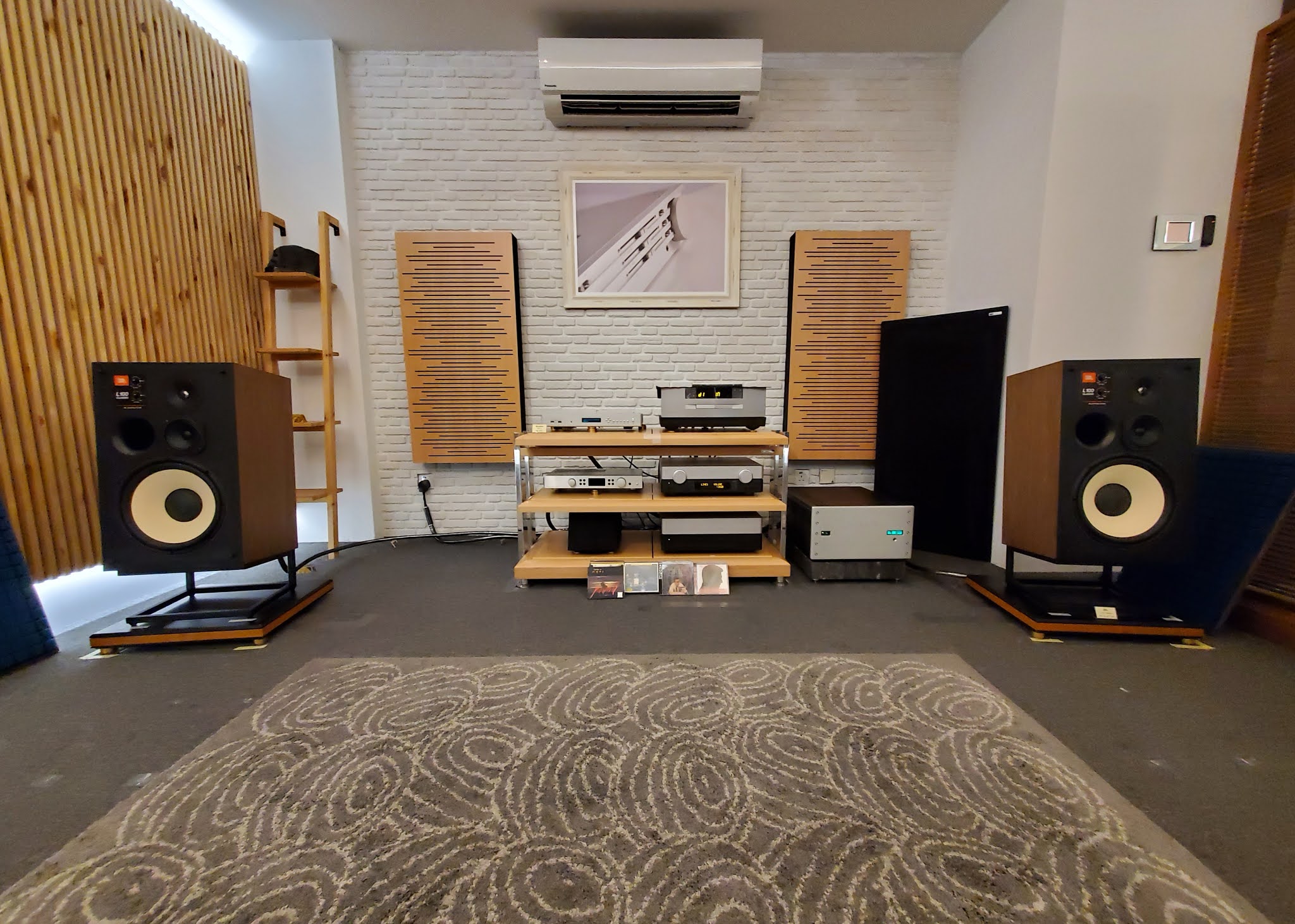
iconic JBL Classic and Studio Monitor Bookshelf speakers series were officially launched for the
Malaysian market by AV Designs Sdn. Bhd. on Friday, 28th August
2020. Four models were showcased - L100 and L82 Classic Series and the 4312G and 4312MII of the Studio Monitor series. The event was done in a small scale in accordance
to the current MCO SOP but that did not stop the organizer from showcasing what
the musical enjoyment these speakers can provide to the listeners.
The
event started off at 3 pm with a short briefing by Mr. Tony Low where he did a lowdown
on the revamped design of the original L100. Came out in 1970, the original
L100 was designed mainly to suit the fans of rock music, given it was the
Woodstock era. This new L100 Classic retains the vintage styling, including the
retro-inspired design Quadrex foam grille (with enhanced material to prolong
its integrity). This speakers boast a 1-inch titanium dome tweeter, 5-inch pure-pulp
cone midrange driver, a slamming 12-inch cast-frame, white pure-pulp cone
woofer and a single front-firing port tube. The L100 Classic also retains the
high and mid frequency L—pad attenuators on the front baffle. With the current
modern touch, the L100 is expected to be more neutral in sound and able to deliver
musical enjoyment of various musical genres. JBL have also come up with a
matching tilted stand, measured precisely at angle to give the speakers the
best musical presentation to the listeners.
The Full Lowdown of the Classic Series
Only
the L100 was on active display with a Bryston BDP3 streamer and TAD
amplification. Guests had the opportunity to listen to these speakers with a
series of music clips and also test tones. From the first impression, the L100
Classic will be a strong contender for those seeking modern sound but with
vintage looks.
What Fellow Contributor - Audio Vault Have To Say About L100?
Fellow contributor to El Hefe's HiFi Review, Audio Vault have something to say about the L100.
Merry Christmas track infused with jazz genre - L100 produced a large staging scale with good layering of instruments. Very musical with clear and clean sound. Good bass control where the low end frequency was delivered with a sense of authority. At the same time, it still maintains an open sound to fill up the venue. The highs gives out the details which provides an excellent sounding contrast. It really delivers the greatness of the track recording.
Move to Ready for Love from Bad Company.Vocal is more natural and the L100 reveals more of its forward character,well-rounded sound that is mostly neutral and with a good tonal balance.The guitar works sound very electrifying.
I loved hearing the drums through these speakers, tapping out the beat on a ride cymbal, the sound of the stick hitting the the cymbal with a natural splash and then hearing it fading into the background. Bass is taut and pounding with powerful low frequencies.
L100 not only able to separate instruments within a crowded sound field, it can also deliver a dynamic distance between instruments and vocals. .
According to Tony, they currently only carry one unit of each model but more units are expected to arrive in the second shipment due soon. The L100 Classic is retailed at RM 19,800 whilst the L82 Classic is retailed at RM 11,200 excluding the matching stands.
These JBL speakers are available for demo at the AV Designs show room. (+603-62411237)
Note: Some of the contents here is a mirror of my write up on Audiofi.net
I remember the time where the users of wireless systems are shunned away by audiophiles and music lovers. The common statement of wireless is inferior compared to conventional wired set up always would be the baseline debate. While there is some truth in it, the technical and quality gap between them have become narrower with time.
While some hifi designers opt for a full deck, cube or soundbar design, KEF stick to what they know best... A wireless music system in a speaker. Take the award winning KEF LS50 speakers, put in wireless module and Michael Young in the equation, shrink it a little bit and voila - you get yourself KEF LSX wireless music system :) . Sounds simple? Well its not that simple if you want to get good sound quality from them.
What Is Inside The Box?
The LSX comes complete with all the required accessories for you to set it up.
1 Master and 1 Slave speaker unit
Power cable for each unit (with 2 pin plug)
Ethernet cable to connect the Master and Slave speaker unit
1 remote controller
The Built
Small but heavy. Each unit weighs about 3.5 kg and stands at 240 x 155 x 180 in dimension. Small to call it a bookshelf speaker but big to call it a PC speaker. The review unit came in a grey fabric finishing which was designed to make it look different form the ordinary speakers. And yes, it comes with various colours.
It is sturdily built with no sign of skimming things on quality that KEF is known for. And of course, one can admire the Uni-Q driver array from far away. The design is equipped with a 19 mm aluminium HF driver and 115 mm magnesium/aluminium allow cone. Caution - the speakers need to be handled gently and only to lift it from the rear side.
The remote is moderately sized with all the main functions to control the speakers. Volume, input selector, play/pause/next/previous tracks etc. Even though made of plastic, it feels right in my hands.
The LSX can also be controlled using the inhouse KEF apps. You have to download 2 apps - The KEF Control and KEF Stream. A bit inconvenient as you have change between the apps back and forth. The latter is to choose and control the music while the KEF control is to choose inputs and control volume.
What Can It Do?
Given the name, the LSX is designed to stream music wirelessly (or you can still opt for a cabled connection) either over the wifi network or bluetooth AptX. Over the network, it reads my Western Digital NAS and SONY HAP Z1 ES with ease. Once set up, you also can pair it with your Spotify and TIDAL account.
You can also connect a digital player such as a CD player or an MD player via an optical cable into the LSX. If your equipment is not equipped with a digital out, you can opt for the Aux In port with a 3.5 mm jack.
As for the output, the LSX is designed with a healthy amplification of 70 watts to the LF and 30 watts to HF. It can go loud up to 102 dB.
Can it play anything under the sky? Unfortunately no. It is limited to a resolution of 192 kHz/24 bit files. Hence, anything higher than that such as DSD, the pair will not be able to detect.
The LSX is also equipped with a special feature where you can set up your own sound profile depending on where you set up the LSX and also your listening area.
For more features, you can download the product info here
The Listening Session
There are various ways to set up the KEF LSX. For my review, I have set it up as follows:
1. Wired ethernet from my router to the Master speaker
2. Wireless set up from Master to Slave speaker
1. S'Wonderful by Diana Krall on WAV 16/44
With standard 16/44 digital file like this, it sounded very natural with the LSX. Diana's vocal sounded soothing and the clarity that this speaker produces really amaze me. Its gives out crystal clear vocal without leaving out the music surrounding it. The music just flow fluently and the LSX reproduces the ambient in a big soundstage compared to the size of the speakers.
2. New York New York by Andrea and Tony Bennett on FLAC 24/96
For a live album, nicely recorded like this track, the LSX delivers the liveliness of a live show with quite airy presentation. It befits the intended sound for a live track. Even though its a live track, the LSX still capable to reproduce Andrea's deep vocal with such boldness and melody. When Tony's vocal came in, the LSX does not have any problem to deliver the a different spectrum of vocal as well. Very versatile to adapt the different depth of vocals. Tony's husky-loungy vocal sounded very natural.
3. Japanese Roots by Takedake on MP3 320 kbps
The wind instrument sounded huge on the LSX and the percussion was also quite entertaining. It digs quite deep given the small size of the cabinet. The highs from the percussion sounded sharp and detailed enough that it does reproduce and overall punchy sound on this track. Surprisingly given the source is an MP3. The LSX somehow injects a different breath of liveliness to this track that people may not realise it is an MP3 file.
4. You Were Always My Mind by Willie Nelson on WAV 24/192
This was the most entertaining track played on the LSX. It sounded big. Bigger than what I thought these speakers can do. Willie's vocal was energetic and extended to give me the goosebumps. It delivers the emotion that this track carry. The piano sounded very melodious where the LSX reproduce the ambient of the song in a very emotional way.
5. Take Five by Dave Brubeck on WAV 24/192
This has always been my reference track when it comes to highs and lows. Somehow I feel that LS50 DNA is in the LSX where the highs from the wind instrument sounded sweet, sharp and full of energy. No sign of fatigue from prolong listening. The low end frequency however was a bit laid back to my liking. I could use with a deeper and punchier bass response for this track.
6. My Hero by Foo Fighters on WAV 16/44
For heavier music like this, the LSX belts out quite a raw sound. This particular track is actually quite complex when it comes to the drums. The works on the kick pedal needs a system or speakers that can handle speed and accuracy. While the LSX is capable doing that, the bass response still lacks a little bit of punch. While it delivers quite a high level of energy for this track, it lacks some dynamics to it. It still does really good with vocal where Dave's vocal was reproduced with such rawness which is required for this track. The guitar riffs also sounded energized and delivered with a powerful loudness.
Overall Verdict
Does the KEF LSX ticks all the boxes on my true wireless system?
Maybe about 90% of it. I am a heavy DSD user. Having to set up Roon to decode DSD before the LSX can play it is a bit cumbersome and will add cost to the set up.
Does it meet my musical expectation?
Yes for its size and price bracket. It might not be the most attacking and punchy speakers but given its size, use it for the right usage, it will give you hours of pleasure.
Is it stable as a wireless system?
I didnt experience any drop out of music signal in my review. But the app to choose lags a bit when changing from one track to another.
Who would enjoy this KEF LSX?
If you are looking for simplicity but does not want to compromise on SQ and also need vibrant colours for your home, look no further as this is a one stop solution. Not for those who seeks for heavy bass reproduction. Suitable for vocal, jazz, ballad and rock. KEF LSX is distributed by Perfect Hi-Fi. For a shop demo, please call +603-58821693. Local RRP: RM 5,699
The new Oppo Sonica WiFi speakers was officially launched in Malaysia today. The event took place in Chandelier Wine and Dine on Jalan Syed Putra and was attended by various media reps including Mr. Dick Tan of 3DotEvent (KLIAV organiser). It was rather a simple affair but attendees were generally impressed with the Sonica which sounded big for a little guy. Steve Chua of CMY was also there to assist in ensuring the Sonica was set up to sound its best.
Mr. Adrian Lee, the sales manager of Oppo Electronics Malaysia presented the brief history and background of Oppo Digital which dated back to 2004 where they debut their DVD player. Followed by the Bluray players, headphones and headphone amp.
The features of this Sonica fits nicely in most modern homes that aim for simplicity and yet, meeting the sound quality. The list of features can be obtained from their website but here are some of it:
Support DNLA and UPNP, hence can play from NAS and USB thumbdrive
Able to pair with another unit to set up a stereo sound
Multiroom capability via a single app
Support hi res music up to 24/192 in various format
...and many more
The Sonica will be available for purchase starting next week from CMY and later from other authorized distributors. The RRP of the Sonica is RM1299.
From my experience listening to this unit, the unit can really go loud without sounding stress. It has high level of clarity and do not underestimate its bass reproduction. The wifi control seems to work well during the event but the ultimate test would be if a sample unit can be brought home and fully tested.
Thank you to Adrian and Oppo Digital Malaysia for the invite.
As I am in the midst of revamping (more like downsizing) my hifi set up, my downstairs living is now empty... in a musical sense.... No more TV nor a hifi system. I still have the Arcadia portable TT and also the Bose Wave system but those have been parked across the dining table.
Luckily my Mrs too cannot live without music, hence I am in the quest of a minamalist system. Coincidently, one of my FB mate, Laz Shamsudin messaged me saying that the Xounts 2.1 system is back in stock on Groupon. And at RM269 inclusive of GST and Postage, this seems to be a low enough gamble.
The item arrived within 5 days. Nicely packed in a box. The parts are smartly packed in the box, ensuring everything is protected in postage.
Assembling the unit took about 30 mins with its clear instruction booklet and the first that was tested .... was the light!
So, What is This Xounts?
It basically a speaker-lamp system that is designed around 2 .1 speaker system using NXT technology. Its basically a pair of mini speakers mounted onto the frame of the unit plus a down firing slim subwoofer.
The Specifications
Incorporated in the system:
1. 3 x 3.5mm Aux In (one inside the unit and 2 in the rear panel)
2. 1 x 2 pins power socket (inside the unit and its for low powered unit)
3. 1 x wireless receiver (inside the unit and uses RF)
4. 1 x wireless RF transmitter (comes with power supply and another 2 x 3.5 mm inputs)
5. 1 x Philips energy savings bulb
So, all together there are 5 inputs to this system.
The power cable is hard wired into the rear panel alongside with volume and bass control with 2 x 3.5 mm aux in mentioned above.
No remote! Which is the biggest gripe for this unit.
The Session
First impression... it can go loud.... really loud for a medium size living room. Bass was a bit muddled, hence I lowered down the bass volume to about 12 o clock on the dial. But clarity was there, crystal clear sound, The sample above is from Arcadia TT streamed wirelessly to the Xounts.
It did take loooongg hours before the SW to open up a bit and sounded more refined. Connecting my faithful Blackberry Passport to the unit via 3.5 mm jack, the overall sound coming from this unit sounded more subtle and refined compared to the wireless mode. The wireless mode sounds a bit harsh and constraint.
Listening to Azlan and The Typewriter's rendition of Jeritan Batinku, the Xounts produced quite centralised sound. Although the dispersion of sound is sufficient to be heard across the hall, but it does not give that full soundstage feeling. Its loud and could deliver the stunning vocals of Azlan... also a thud thumping experience when it comes to the double kick pedal of the drums. But it still sounded 1 dimensional.
Playing a hi res file of Eagles Hotel California via the RF wireless streamer, I can feel that this wireless module somehow does not deliver the refined and detail of the hi res file that I have.
After more than 200 hours of running in, only then I can start to experience a more open sound, with less restrain on the musicality. The sound is more airy and have some energy to it. Compared to before where the sound was quite flat, this unit now delivers a more lively sound with sufficient bass control and depth. I find that setting the bass dial to about 1 pm, gives the the best result.
Placement of the unit is also important. Its better to have the area on both sides free from big furnitures.
Many Inputs is Enough?
Now, if I was the designer for Xounts, this is how I would spend my cost on to rather than offering 5 inputs:
1. Just 2 Aux input
2. Replace RF module with the option of Bluetooth or WiFi
3. Remote... at least for the volume.
The RF module...although sends out a very stable signal, is not portable. You need to connect it to a power source and stationed it near your source. Hence, its not portable at all.
And each time I want to reduce the volume, I would have to go behind the unit and meddle with the small volume knob.
Very inconvenient for a lifestyle speaker design.
Because of this, I had to enhance the Xounts capability by adding a BT module.
QED uPlay Plus
I used to own the famous QED uPlay Puck BT module. But since I have purchased two BT enabled DACs, I have since sold the unit. I was actually planning to re-purchase the puck, but it is no longer in stock. Hence, I had to settle with the uPlay Plus.
Setting up is simple. The beauty of this unit is that I can tap the power source from the internal 2 pins plug socket inside the Xounts. I then use an stereo RCA to 3.5 mm cable to connect to the rear aux in for the Xounts. The uPlay Plus unit fits nicely underneath the Xounts, just beside the down firing SW.
Connected to my BB Passport, I played the hi res file Hotel California again. Voila, instant change in sound signature. Via BT, I feel that it helped the Xounts to give more justice to hi res sound files. The percussion now sounds more punchy and natural and the guitar plucking sounds more natural. The overall song sounded more involving.
And with this addition to the unit, I now have control on all the music I have stored on my phone and also on my 4 TB NAS over the home network. Plus, I am now able to control the volume from my phone. I just set the volume knob on the Xounts at 12 pm, and I control the volume on my phone.
Conclusions
For RM269, this is much better than a mini compo which I used to adore growing up with them. However, at its original price of about RM2800, I would not suggest to anyone who is fussy with audio quality from a unit. Its overall design is a bit behind time with minimal convenience of the modern hifi world.