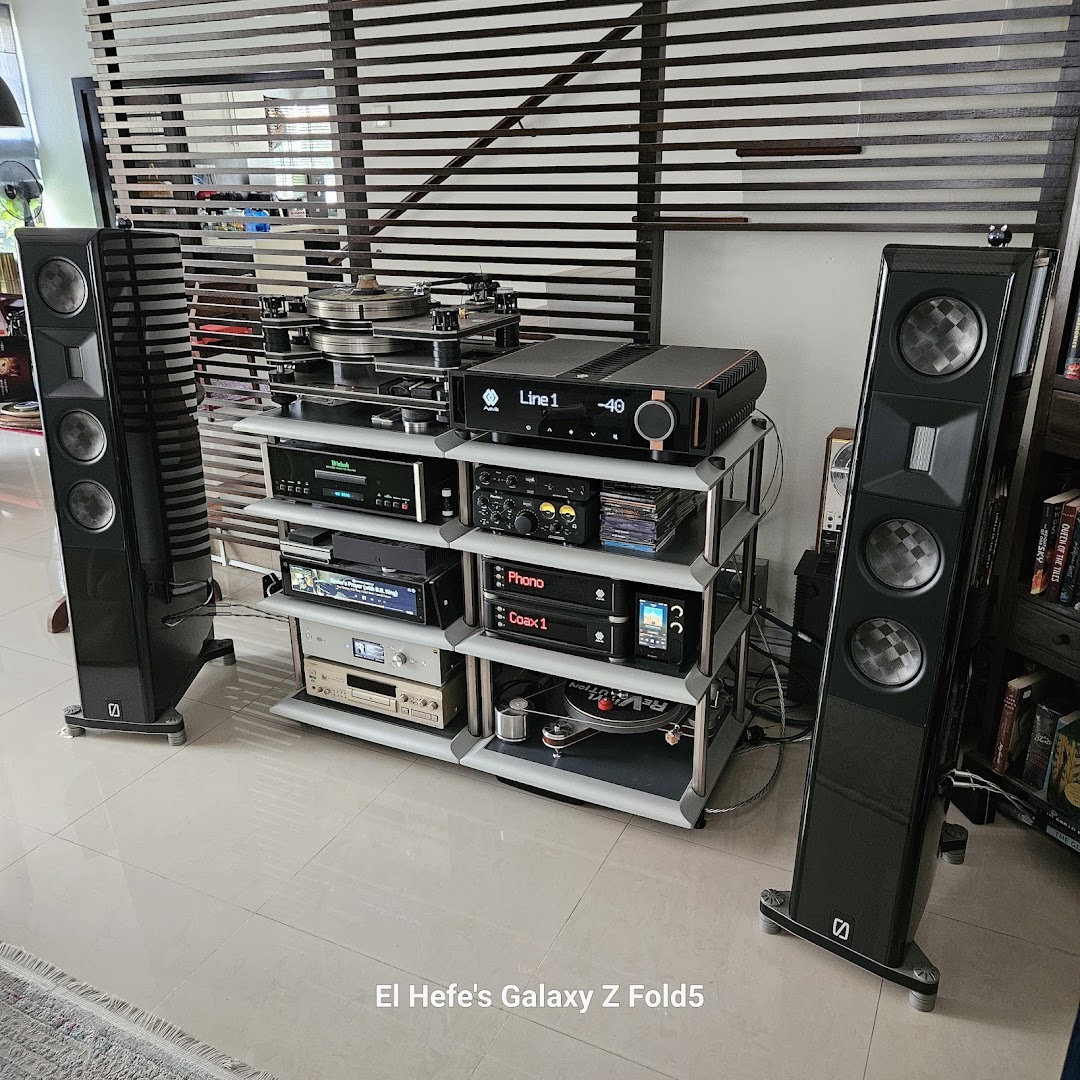
Spent about 2 hours, mesmerized by these wonderful speakers. All the clarity, highs and mids that I enjoyed a couple of weeks back were still there. But this time around, the low end was really refined but still gutsy enough to give that thumping to your heart. It was really tonally balanced regardless of what music genre you play. And we really played today. James and Tony at AV Design were excited themself but I was even more excited. Today, these speakers were driven by the pair of BP17 pre amp and the 4BSST2 power amp. Wired by of course WyWires. Source was through BDP2 and BDA2.
We threw in Dire Straits, CCR, Pink Panther theme, Metallica, Stan Getz and Gilberto, The Eagles etc....MP3, WAV, FLAC, hi res.....and the speakers just smile at us, performing its best (though cant wait to listen to them in the AV show this year in a bigger room). We played it loud today and the bass was so refined and detail and did not muffle at all. Each bassline and kick pedal was clear, solid with no sign of distortion. And it did not overshadow the clarity and crispiness of the mids and highs. It was goooddd.
The one thing that really stand out was on wind instrument. I think it was a clarinet playing. I can even hear the extend of the musician breath to play those long notes.
You guys just need to experience it yourself.
I do believe what Bryan Russel mentioned few months ago... audiophile quality at affordable price (well at least to some)
Samples of the music through these speakers:
These speakers alongside the new BDA-2 DAC, BDP-2 Digital player and BP17 Pre amp can be auditioned at AV Designs, Bangunan Rohas Perkasa. Call Tel: +603-2171 2828
Had the honour to test out this amp for over a month. This is mirrored review from Audiofi.net.
First impressions: Unmistakably NAD! Anyone familiar with the Canadian company’s designs can tell this from a mile away. The one item that differs from NAD’s entry-level amplifiers is the VFD (Vacuum Fluorescent Display) screen.
However, the weight of the C 390DD (direct digital) integrated amplifier surprised me when I removed it from the box, being relatively light compared with NAD amps I had previously encountered. Given the 7.7kg weight, it was hard to imagine this amp’s rated to deliver 150 watts per channel.
Setting it up was easy enough as there was no requirement to handle thick analogue stereo interconnects. All inputs are digital, hence a single wire each for coaxial, optical, AES/EBU and USB A-B is all that’s required, besides the speaker cable.
Once the amp was up and running, the first test was done via my faithful Musical Fidelity M1 CDT transport connected using Siltech AES/EBU digital interconnect. Fresh out of the box, this amplifier delivered the heart-thumping drumbeat of Foo Fighter’s My Hero track with precision and detail, providing a gutsy performance. However, it was not the most expressive and involving first impression. There was still something missing. Read on …
Specs:The build quality is nothing to shout about and to some, it might feel a bit plasticky. The inputs, however, are sturdily built with good quality speaker terminals for bi-wiring, tight-fit USB connections and an array of digital inputs. Even the remote is ergonomically designed for easy control.
The fascia comes with a bright digital display which can be dimmed to your preference. There are a standby soft-touch button and medium-sized volume knob. For source selection, NAD opted for a left-right toggle button. There is also a USB-A input for a quick plug-and-play using thumb drive. This unit is also equipped with a navigation scroll function to adjust several parameters such the treble, bass and balance level.
The amplifier comes fully equipped with all the common digital inputs and outputs. And as the name suggests, everything is kept in the digital domain, from source right to the speaker outputs. There is, however, the option to install an analogue module.
The digital inputs are two USB-A (compatible with the common audio formats), one USB-B (24-bit/96kHz), one balanced (24/192) and two optical (24/96) and two coaxial (24/192). One digital coaxial and optical output each are provided, as are a pair of RCA outputs for a subwoofer or two. System power on/off operation can be effected via the 12V trigger input/output.
NAD claims the C 390DD outputs 150 watts per channel into eight ohms, and includes four sets of speaker terminals to allow bi-wiring. For those audiophiles with a thing for wires, the power cord here is detachable. There are also functions to adjust treble, bass and balance.
The MDC (Modular Design Construction) approach ensures future-proofing – two optional modules, the DD HDM‑1 and the DD AP‑1, can be installed. The former allows the user to integrate the C 390DD with a Video 2.0 system, using Blu-ray or DVD as source. Three HDMI input terminals and one HDMI output with video pass-through will allow two-channel audio and 3D compatibility.
The AP-1 allows analogue source compatibility, having a pair each of single-ended and balanced inputs, and even an MM/MC phono section.
Another unique feature is the amp’s capability to run a Room EQ test (scroll to end for video). NAD has devised a very simple test sequence to make the adjustments by ear (or using an SPL meter). It employs the same concept musicians use to tune a stringed instrument, with a slight twist – instead of matching frequency or pitch, the unit will match loudness levels. This is mainly to cure standing-waves issues in the room. Playing back the Room EQ test sequence allows this problem to be easily handled via your ears and the amp’s Room EQ filters.
Performance:I took the liberty to test every single digital input on the amp. I even bi-wired my speakers just to hear how it faired against my usual bi-amped set up. Only one track was used but in different formats. I chose The Eagles’ Hotel California track (live version) as my reference as I believe this provided me with the entire required music spectrum.
First to be tested was the balanced input. The amp delivered a certain level of detail and emotion of the live performance. The guitar strumming was smooth and solos were detailed, note by note. Percussions sounded tight and convincing.
However, I did not experience the usual live ambience that was possible in my own system. This was, however, with the volume at a lower level. I pushed the volume up and it did improve the overall ambience by a bit but this should not be the case for a gutsy 150-watt amplifier. I was expecting a more natural spatial simulation at lower volume.
Next, I tried the same track via the coaxial input from the same CD transport. Things sounded flatter but there still were the detail and precision of the balanced mode. As both inputs can handle up to 192kHz, there was only a subtle difference in the overall performance between these two inputs. The main difference, of course, was the gain level. I had to turn the volume up with the coaxial input to get a more natural live air.
I then switched to optical input. For the fun of things, I did not use a CD this time. I have this track on a Minidisk in ATRAC format and used my faithful 14-year-old Sony MD player – and I played this track over and over again. Why? This is when I noticed the biggest change and improvement, compared with the MD player via its stereo outputs on a regular analogue amplifier. The NAD C 390DD injected a new life to the format, bringing up the performance to a similar level as my CD transport.
Moving on to a computer audio system (CAS), I used the MPlayerX on a Macbook Pro and the NAD amp was easily recognised by my laptop. Choosing the NAD as my main audio output, I started by playing Hotel California in FLAC format. No sound!
I then played the MP3 version on iTunes and it turned out fine. A quick reference to the NAD manual solved the issue. The USB-B input can handle signals of only up to 96kHz. Changing the output setting on my laptop solved the issue – however, the track was now down-sampled to 96kHz.
The overall live ambience of this track seemed suppressed, which made it sound muddled. The detail and precision were lost compared with the CD and MD source. There was still some level of the gutsy performance but the ambience was no match to CD or MD. I was a bit disappointed, I must say. Playing the MP3 version (48kHz/320 kbps) via iTunes provided a better experience. The overall sound was more natural and closer to CD. I conclude this input was the best for straight iTunes application, with standard MP3, ALAC or AAC audio files.
Now, the USB-A inputs (front and back) are even more limited compared with the USB-B, allowing only up to 48kHz files and recognising just MP3, WMA and FLAC formats. A second disappointment here. I felt that these two inputs were present more for convenience rather than providing the latest digital offering.
For the sake of testing its functionality, I loaded the MP3 files and FLAC onto a thumb drive and hooked it up to both USB-A inputs. The amp easily recognised it and displayed the track name. The MP3 files played fine and gave out a similar experience with the CAS but the FLAC files, being 192kHz, could not be played.
The good: The C 390DD is a true all-in-one digital domain amp with the benefit of Room EQ. For a minimalist system, you can do without the additional DAC kit and just get a laptop or CD transport. The amp has enough power to drive speakers to their limits without distortion. It also is detailed and precise, with guts to rock out even with the lightest of rock music.
The MDC means users don’t need to worry about the future – with two more slots on tap, NAD will continue to provide the latest and updated modules for the ever-growing digital domain. And for those who like to tweak the sound, the treble and bass adjustment functions will suit you well.
The ungood: Even with the power on tap, the NAD did not always deliver the expressiveness and liveliness of some other amplifiers in its price range. Being a digital amp, that’s what it does exactly – produce a digital sound.
The specs of the USB inputs are the biggest letdown. While other manufacturers are making 192kHz the minimum “standard” for their DAC or digital inputs, NAD has limited it to 96kHz on USB-B and 48kHz on USB-A – at the price, there is no excuse for this. The high-resolution music market is growing so rapidly that there are already DAC manufacturers producing up to 384kHz.
Final verdict: The C 390DD is a good attempt by NAD to cater for its digital domain consumers, who will benefit from long-term upgradeability. There is no lack of power as well on the amplification section as I believe it can drive most commercially available speakers.
If simplicity is your preference, this amp is the one for you. It might not be for everyone, especially analogue lovers, as the results can be a bit digital sounding. But the amp makes up for this with its precision timing and detailed presentation.
C 390DD Software and Room EQ Feature Video:
Gear: Sources: Macbook Pro running iTunes for 48/320kbps for MP3s and WAV files, MPlayerX for FLAC; Musical Fidelity M1 CDT CD transport; Sony JA20ES MD player / Speakers: ProAc Response D18 / Wires: IXOS 604 speaker cables, bi-wired; Siltech balanced interconnects; QED optical interconnects; Cambridge Audio 500 Series coaxial interconnects; Supra 2.0 USB cable
Price:£2250 / US$2600 Malaysian price: RM12,485 Malaysian distributor:A&L Audio Station (+603-2282 9884) /index/ / Find your distributor.
Just received this from the local dealer LTB Enterprise....First demo impression in the shop...the sound was smoooottthhh...
Watch this space for the review...
Its a been a week now...and I was facing the challenge to start the write up....because I was enjoying this DAC a little bit too much. I must say sorry to my Clearaudio TT for neglecting her for awhile...
I am ready to start the write up now while I wait for my own black unit to arrive as I have just confirmed to purchase this DAC yesterday :). And you want to know why I decided to upgrade from my M1 DAC which was already sounded good to me. Read on my good readers....
BUILT
The unboxing reveals the usual classy and elegant packaging of an M6 series kit, comes complete with a black velvet bag, a pair of white gloves and cleaning cloth. It is advisable to use the gloves to set up the unit. Look at the fingerprint smudge if you dont.
The sample unit I received had a serial number of 4.... ie this is the 4th unit produced by MF. The dealer has the 3rd unit. I wonder who has number 1 and 2?
The width of the unit compliments my M6i amp but the DAC is actually slimmer in height.
The unit is relatively heavy for a DAC, weighing at 10.8 kg. The overall built is of high quality and aesthatically looks good too. The remote control is of the similar remote of the M6i and can control my M1 CDT. Sadly, the DAC remote cannot control the M6i amp and vice versa.
The fascia is well designed with a very clear blue LCD display and digital input, de-emphaziser, filter, power, standby soft buttons.
Power cord is a bog standard UK 3 pin, so good news to all those who likes power cord tweaks.
Now, the digital inputs and outputs connections are gold plated and firmly fitted to ensure good connection with your chosen interconnects.
It also comes with an antenna plus extension cable for its bluetooth capability and also USB192 driver CDROM.
SPECS AND FEATURES
This is one well equipped DAC that covers different type of input. Anthony Michaelson went with a topography of recent years which is to limit up to 192kHz rather than the push for higher upsampling resolution. It consists of two 24 bit DACs arranged in a fully differential balanced dual mono topography.
This DAC also allows a complete bypass of digital signal if one wish to connect to a digital recorder.
This unit comes with the following inputs and outputs:
INPUTS
1. 2 x coaxial
2. 1 x USB B asynchronous compatible with Windows, Apple and Linux OS
3. 1 x optical
4. 1 x AES Balanced
5. 1 x Bluetooth with AptX and can store up 16 pairings.
6. 1 x 3.5 mm mono jack trigger in
NOTE: All inputs accepts native 24 bit 192kHz signal except for optical (96 kHz) and Bluetooth (48 kHz)
OUTPUTS
1. 1 x coaxial
2. 1 x AES Balanced
3. 1 x optical
4. 1 pair of RCA
5. 1 pair of XLR balanced
6. 1 x 3.5 mm mono jack trigger out
NOTE: All outputs allows native 24 bit 192kHz signal except for optical (96 kHz). Bluetooth signal is upsampled to 96kHz.
There is a FIXED/VOLUME MATCH switch at the rear part. If volume match is chosen, user can adjust the output signal of each digital input in the range of 0 to +10 dB.
The LED display can also be dimmed and shut off completely.
The FILTER function allows gradual or sharp roll off digital filter characteristics.
Ther DE-EMPHASIS function allows control of the source that contains pre-emphasized digital audio. ??????.... Yes....have no clue what this means. Quoted from the manual.
THE SET UP
1. MF M1 CDT connected with Siltech AES balanced Interconnect and QED Coaxial Interconnect
2. Sony MDJA20ES connected with QED optical cable
3. ASUS Window Vista laptop, using WMP and iTunes connected with Noops USB A-B cable
4. iPhone 5 and Blackberry Z10
5. The M6 DAC connected to M6i amp using Siltech XLR balanced interconnect and Siltech RCA interconnect
6. ProAc D18 speakers biamped by M6i and M1 PWR amp with Siltech 330L Anniversary speaker cable
THE MUSIC
1. Janet Seidl - Till There Was You (CD)
2. Andrea Bocelli - Time To Say Goodbye, Dare To Live, Vivo Per Lei, Because We Believe (CD, 192 kHz FLAC)
4. The Eagles - Hotel California (CD, 192 kHz FLAC)
5. Bad Religion - American Jesus, Kerosene (CD)
6. Etta James - At Last (MP3 320 kbps/48 kHz on iPhone5 and BBZ10)
7. Kevin Kline - La Mer (MP3 320 kbps/48 kHz on iPhone5 and BBZ10)
8. Earth, Wind and Fire - In The Stone, September (MD)
THE SESSION
I didn't start the review with the traditional notepad opened and start to jotdown every single experience I have demo-ing this DAC. I was quite mesmerized by the first 15 minutes of listening to it in the dealer's shop. Heck, and that was mainly via bluetooth from my iPhone5. We were going from one track to another. But playing Etta James and Kevin Kline reveals that this DAC is not just another DAC that MF decided to come with.
CD REPLAY
When I brought it home, the first track to go in was Janet Seidl - Till There Was You played via AES connection. The immediate change from my M1 DAC was the elevation of the overall musical ambience from her vocals and ukelele. Its like the spectrum has elevated; the mids and highs were giving a different level of clarity. Further listening reveals a more involving experience. The low end was not to impressive at this moment. Switch to Coaxial connection, the overall ambience was taken down a notch. That didnt help to bring up the low end spectrum.
Not wanting to say the DAC was now overly smooth, I switched to Foo Fighters - My Hero via AES. YES, YES AND YES. This is when I start to realise that the bass was actually extended as well. It was further dispersed but still well controlled. Again, it was like the DAC amplifying things to a hier volume but instead of distortation, it injects a certain enhancement which I believe is the upsampling quality done by the unit. Switching to Coaxial, again the experience was taken down a notch but that didnt take away the involving experience. This was again one of those moments that made me want to jump onto my drums and start drum-aoke along with the Foos.
Playing an old not so good recording of Bad Religion famous album Recipe for Hate from 1993, the DAC actually makes it enjoyable to listen to older recordings. The punk rock music sounds more alive and 'recent'. Again, I think the DAC has elevated the overal presentation of music.
Mellowing down the rock side, I switched to The Eagles with their live version of Hotel California. The string workson this track was so defined that even my 6 year old son who sings along Gangnam style, went 'Wow, dad....I like this guitar sound!' And when the drums kicked in, my my my it further confirms that I may have been missing a fuller bass compared to M1 DAC. It may not be to everyone's liking on the bass side but I like the way the DAC extends the low end further but still maintaining the overall smooth sounding character.
COMPUTER AUDIO SYSTEM - USB INPUT
While listening to this track, I started to boot up my ASUS laptop to compare the CD to the 192 kHz FLAC version. Connected to the DAC via a 5m Noops USB A-B cable, the laptop immediately detected the DAC and prompted for the driver to be installed. Loaded the CD-ROM, and followed the step by step installation instruction. 2 minutes and done. Unfortunately, after that, it can no longer detect the DAC. :(. Reading up the manual, it says to use a cable less than 5 m long. Hhhhmmm...so went through my cable bag and found a 1.5 m USB cable...voila...now it can detect. Not really sure why as the 5 m cable worked OK with the M1 DAC and when connected directly to M6i USB input.
Putting on the FLAC version of Hotel California reveals a relatively similar experience but with a little bit more emphasize on the mids and highs. This has made the song sound more tonally balanced as the low end is now not as overwhelming as the CD version. Still have the extension that I want though. The DAC also displays the incoming signal from laptop.
Just to ensure it was not a mind trick (or is it ear trick?), I stopped listening to this DAC for a few days. And resumed the session with more of my favourite tracks.
Now, I never miss playing Andrea Bocelli in all my reviews. So, up next was a string of his FLAC tracks. It reveals how good his recordings are. Not only the music, but the mixing of the tracks itself. Time To Say Goodbye sounded even more airy and powerful with the vocals sounded so refined. The soundstaging was elevated to a level where it made the sound as if I am in a concert hall but without the echoes. It was really refreshing and alive.
Ok, at this stage I am convinced that the M6 DAC when it comes to CD and CAS replay, its above the entry level M1 DAC. Dont get me wrong, I think M1 DAC is still the best DAC around its price range. But this M6 DAC even sounds more refined than the M6 CD player which I tested a few months back. Now, I was told that the M6 DAC uses a different DAC topography than the M6 CD player.
And in general, AES and Coaxial gives the similar characteristics but the AES has this extra kick as it injects a little bit more refinement, smoothness and extension across the musical spectrum.
BLUETOOTH APT-X
This is what really impresses me; the Bluetooth module. Connecting my iPhone 5 and the new BBZ10 takes about 5 seconds. I am a little bit puzzled now on this. My music files are MP3 320 kbps/48 kHz on both phones but from the iPhone 5, the DAC shows that the signal feeding into the DAC is 44.1 kHz. But from the Z10, it shows as 48 kHz. Not that it made a different in the sound but just curious why.
The way of the volume is controlled is also different. With iPhone 5, the volume on the phone is still active and I had to balance between that and the volume on the amp. On BBZ10, the digital volume on the phone is deactivated, so I only had to adjust the volume on the amp. Weird to me. But I prefer the setup of the latter.
The sound of Etta James and Kevin Kline was really mesmerizing. And the phones are not even Apt-X enabled. If the DAC is connected to an Apt-X enabled device, it will display an Apt-X icon on the LED display. Connectivity was also stable with no dropouts throughout the 1 hour session with various other music. It was difficult to distinguished between Bluetooth quality and the CAS version of the same song. However, the clarity and liveliness is not as per CD replay. But comparing to my BRIK BT Stage and also QED uPlay, they are miles away from this gem.
MINIDISK REPLAY - OPTICAL
I do have quite a healthy collection of MD albums and also recorded ones. And as this format has been forgotten, it starts to become quite difficult to keep up with CAS and DAC technology. My SONY ES player was the king in her MD reigning days and even with its built in DAC, it was sufficient to deliver good quality music alongside portability of the format. But now, only an external DAC will do more justice to do this format.
Playing Earth, Wind and Fire through the optical input did inject more life and made them sounded less digital. However, the flatness is still there due to the compressed data on the MD. However, the presentation and soundstaging did improve and made me feel like dancing (and that is something no sane people would want to see :)). The sound although flat, did have that sense of authority in delivering the low end of the music.
OTHER FEATURES
I did play around with the filter settings and de-emphasize function. Eeeerrr.... didnt hear any changes when switching between fast and slow roll off. So, I didnt bother to really test it.
CONCLUSION
The good: This unit reenforces MF leadership as one of the earlier companies to adopt stand alone DAC units. It is a very refined unit and matches well with theerest of my MF set up. It compliments well with a basic CAS and also other digital sources. It did make me wanting to get serious into CAS again.
Would be even better: If MF starts to keep up with the fast paced DAC development in the industry...there are more and more companies going into 32 bit and 384 kHz and also DSD decoding. Especially at this price range.
Am I buying it? Eeeerrr YES. Waiting for the black unit to arrive.
The M6 DAC can be purchased from LTB Enterprise, Subang Jaya. Call Tony for further enquiries: 0193388577.
The RRP in Malaysia is RM 11,000....and in the UK is GBP 2,000
Wednesday, 6th March: I arrived at about 645 pm....only because I went to the WRONG hotel hahahaha. I dont know why but I thought it was in Saujana Subang. Only to realise when I walked into the lobby and the reception went blur when I asked about the event. Then rushed into the Subang traffic to get to the Holiday Villa.
Walked into the venue, there was already so many people. The only familiar face to me was Jo Ki. Then Kuan Yew Nam the organiser greeted me and showed me the registration table. Got meself registered and received the Kef 50th Anniversary pen and the Audiphile CD (forgot the title). From the name list, there was about 65 attendees.Then more familiar faces came in James Tan of AV Designs and Felix. After the usual meet and greet, at 7 pm, announcement was made to kick off the event.
Mr. Kuan gave the opening speech thanking everyone for their attendance and support also all the hifi companies which provided the gifts for the lucky draws. Followed by the event facilitator Jo Ki presenting the profile of the 6 speakers for the event and also the guideline for the night. Each speaker is given 15 mins.
Jo Ki also slotted in a surprise talk by Mr. Kuan himself.
Kuan briefly explained the importance of 3 basic elements in getting good sound quality from CAS.
1. Good quality cable is mandatory. Even better to take SATA cable between the hard disk and motherboard out of the equation and replace it with a microSSD. It will allow wider bandwith and faster data transfer.
2. Store songs on the RAM and not the Hard Disk and avoid using virtual memory.
3. OS setting to fine tune the system controlling the main items; DEMON, Processes and Services to only handle music and avoid multitasking.
1. Dr. Paris Ng (The Digital Playback)
The Dr. emphasized on why he went into CAS. Mainly for convenience and portability. Setting up playlist is one of the main feature of CAS that he likes so that he can do without switching between CDs. One important statement from the Doc was that with digital playback, for the first time we can hear the same resolution with the recording resolution.....no more degrading ....on a newer recording and the analogue transfer through DSD or HR PCM! 128 times from cds - no more of downsampling through CAS.
2. Mr. Danon Han (An Audio Analogue Perspective)
He basically brought us back in time where how a simple RM1000 Rega TT of his friend, plugged into his flagship Mark Levinson set up, and soon after that he was converted into the black disc curse. Eversince then, he never turn back (of course at that time, he did not admit to his friend that the Rega TT basically gave a better sonic performance compared to his CD Transport and DAC).
3. Mr. Vattana Prasertnasung (A Hobbyist Turn Owner of An Audio Company)
This to me was the highlight of the night. His wittiness and chirpy character made me feel how passionate he was about music and hifi. His famous line is 'I Like To Play With My Hands' referring to his continous DIY experience in producing speakers and cables. When he was a student, he was saving money for 3 years to buy his dream Canton speakers in which he went to the hifi shop almost every other day. The speaker cost 32M baht...in which after 3 years he only gad 28M. But the hifi shop owner sold him the speakers for 28 M baht but told him never to come to his shop again hahahaha. He had 2 failed companies (Audio Project and Acoustic System Design) before launching his 3rd and current successful company Tombo Audio which is famous for his Kevlar design power cable.
4. Mr. Wijit Boonchoo (The Way Thai Audiophiles Listen to Music)
Mr. Wijit is no stranger in Thailand AV industry and journalism world. He currently writes for several Thai magazine and also a TV channel (Mango TV I think). This is the best part where in the true Fellowship spirit, language was not a barrier at all. Mr. Wijit did his talk in Thai and had a translator but that did not hinder the attendees interest in listening to him. His most valuable advice was: Regardless the price of your system, if cannot deliver realistic sound, then it is a failed system.
5. Mr. Gan Hock Ho (How a Veteran Audiophile keeps the hobby going)
Mr. Gan here...was definitely the funniest hifi connesiuer I have ever met. His 'sexual innuendos' hifi terms made attendees laughed their butts off. Some of the terms were in Chinese but I had James Tan beside me translating them hehehehe. Gan remembered his teaching days with a salary of RM585/month...How to play hifi? He also thanked various people like Jo Ki, Kuan, Peter Leong, Ben Tan, Frankie Voon (for his famous Frank Power Bank) and Dr. Who from hifi4sale forum.
6. Mr. TK Han (Development and Trend of Hifi Industry)
Last but not least, Mr. TK Han shared his views on the nearby future of hifi.
- Price will continue to increase
- Knowledge of audiophile will be further elevated
- CAS...the heart of hifi shows
- higher spec DACS even up 768 kHz...decoding DSD, DXD
- Vinyls will with stand the test of time
- Digital amplifier will continue be developed and loved
There were several lucky draws were done inbetween the speakers and Mr. Song Soon Onn was another jovial character that made the night more fun.
Yours truly was also among the lucky ones to have won something. A Boston Acoustics iDS2 iPod dock speaker system from CMY.....wooohooo thanks.
The last part was a Q&A session ....where the 6 speakers gave their last words and wisdom to about 5 questions from the floor. Sorry all....was already nearly 11 pm...and my tummy was full with the nasi minyak, ayam masak merah, sambal udang, roasted duck, pengat pisang, fruit, rojak and coffee. So stopped jotting down stuff heheheh.
Overall.....SUPERB, EXCELLENT, PLEASE DO IT AGAIN NEXT YEAR!
Congrats to Mr. Kuan and his team for pulling a very successful event.
EVER wondered how manufacturers name their products? Do they have a team just to think up names? However, Sweden’s Jenvig Technology AB, which makes Supra cables, keeps it simple – this particular product is simply called the Supra USB 2.0 Cable. Nothing fancy here.
What does it do? The name says it all. It’s used to connect a USB-enabled desktop or laptop to a DAC. As a matter of fact, it can also be used to connect a printer with a USB B input.
The Supra USB 2.0 is a flexible cable with a dual screen to provide protection from unwanted RF interference. The design includes two twisted pair of screens, one for signal and one for power. It is also claimed that this design is suitable for long runs as it has low capacitance and efficient noise rejection. It is available in 0.7m, 1m, 2m, 3m, 4m, 5m, 8m, 10m, 12m, 15m lengths.
Both the A and B USB connectors are 24K gold-plated and fully shielded. The design also employs PE-insulated wires with correct 90-ohm impedance.
The Supra is compatible with USB 2.0 and 3.0 sources but, of course, the latter is not usually used for audio. This cable can handle high-speed 1200 Mbps data transfer up to 15m.
When I plugged the cable into my Window-based PC and Musical Fidelity M1 DAC, the first thing I noticed was the extra punch of the kick drum and tomtoms on the track Jeritan Batinku by Azlan & The Typewriters (originally by P. Ramlee). The drummer in this band is known to be adventurous even on simple songs. The Supra cable delivered the punch and speed when reproducing each beat of the drums.
After using it for more than a month, it was very clear to me why this cable is being raved about as a “bang for buck” upgrade for computer-based audio systems.
I play a lot of heavy metal music, from the torpedo speed of Machine Head’s double pedal drums to Kirk Hammet’s swirling lead solos with Metallica. Compared with my RM25 (US$8) USB cable bought from a local IT store, the Supra had more detail and clarity, while maintaining the punch I mentioned earlier.
Vocals, however, were not the cable’s strength, sometimes overshadowed by the heavy drums and guitar riffs. Just for comparison, I played a rendition of Kiss from A Rose by Aiza Sequera – again, the vocals were a little overwhelmed by the heavy bass. So, not the most neutral cable, I must say.
Overall, this is a cable with a great sense of rhythm – it provided a detailed and punchy ambience but still injected a relaxed air to the proceedings. This cable will also enhance bottom-end extension on set-ups that suffer from flat bass.
However, the emphasis on bass can be a bit overwhelming. If used in a bass-heavy system, it can make the music sound muffled.
Given the price, the Supra USB 2.0 cable is a no-brainer if you’re looking for a bargain upgrade for your computer-based audio system – this is a quick and painless upgrade from stock USB cable.
Those looking for an elevated experience from their fast-paced music should try out this cable. It could enhance your understanding of how your favorite musicians physically play these songs on their instrument.
Gear:
Source – Windows Vista ASUS laptop running Windows Media player for FLAC, iTunes for 320kbps/48kHz MP3s and WAV files / Amplification – Musical Fidelity M6i + M1 PWR power amp / Speakers: ProAc Response D18 / Wires: Siltech Classic Anniversary 330L
Price: £29 per metre
Malaysian price: RM269 per metre
Malaysian distributor: A&L Audio Station (+603-2282 9884)
In the past few years, there are international bands that have announced their kin interest in reuniting with their old band mates to come up with new albums. Some even go to the extend of having a reunior concert tours. While some are genuinely in love with writing up music and performing, some however IMHO are just an act of desperation for maybe money...and maybe fame...
As a music listener and fan of these bands, I was curious to hear how these bands would sound after coming out of so called retirement. And the following is how I rate their come backs...
1. Guns N Roses - Chinese Democracy (2/10)...the worst come back...it may even killed Axl Rose career permanently...
2. The Cranberries - Roses (8/10)... Great come back but nothing to be overly excited about as the music genre still the same and no new injection of fresher songs..
3. No Doubt - Push and Shove (9/10).... Excellent come back album.... Gwen is the only female rock singer that can still pull a teenage act and get away with it...
4. Soundgarden - King Animal (5/10) ....Neither here nor there...quite a mellow come back...no really strong tracks worth mentioning...
5. Aerosmith - Music From Another Dimension (7/10).... Carrie Underwood???? Really? Maaaannn American Idol has really messed up Steve's direction...but still a rocking album...
Whatever it is...they still make at least a few million bucks...so ...come back? Why not...
I became very intrigued by the melodious and soothing sound of Yusuf Islam for the past few days. So, I decided to go on a personal quest of acquiring his album on LP prior to his faith conversion.
I was lucky to have found this LP yesterday in RC KLCC. Modestly priced at RM104 and with my 'frequent buyer' miles, I got it for RM94.
And I must say Cat Stevens was already mellow and calm even prior to Islam.
JVC Kenwood Malaysia Sdn. Bhd has recently launched their latest state of the art 3D home cinema projector line. The event was held at AV Designs in Rohas Perkasa on 22nd January 2013. The members of local press and hifi blog scene fill up the venue, anticipating for something captivating from this new JVC line up.
The event was graced by their Managing Director, Mr. Takahide Sakamoto who gave a keynote address at the beginning of the event. He claims that this new lineup is a big step up from their existing e-shift technology (now known as e-shift2). Combined with the improved Multiple Pixel Control, JVC Upscaling and Enhancement technology, consumers will experience full HD images reproduction with maximum definition and also convert them to even higher quality 4K-resolution images. The upscaling will work with any sources like BluRay, DVD and even Astro B.yond.
Together with the Sales and Marketing Manager, Mr. Steven Woo, 4 new 3D projectors were launched in Malaysia under the Reference Series. The models are DLA-RS66, DLA-RS56, DLA-RS48 and DLA-RS46. With the exception of DLA-RS46, all of the projectors offer High Definition 4K-resolution (3840 x 2160). The DLA-RS66 and RS56 also carries the THX 3D Display and Imaging Science Foundation (ISF) certification badges.
One of the big challenge of the 3D market for projectors and TVs is fatigue experienced by consumers for prolong viewing. With a new 3D circuit in the projector topography and newly designed RF glasses, JVC hopes consumers will have more stress free viewing experience.Attendees get to experience with two different home theater set ups in the venue. The DLA-RS48 was set up in a smaller-home-like room, projecting onto a circa 105” screen. Using a Disney PIXAR 3D animation movie clips, attendees get to differentiate between ‘standard full HD’ and the 4K upscale.
There are five different 4K profiles to choose from depending on the source being played.
·Film: Suitable for BD, taken and recorded by film originally
·High Resolution: Suitable for BD content, taken in 4K
·HD: Suitable for BD content from a few years ago and Astro B.yond (1080i or 720p)
·SD: Suitable for DVD (480p)
·Dynamic: Any content
·Consumers will also have the option of turning off the 4K upscaling mode.
The group then moved to AV Design state of the art home theatre set up in a bigger demo room where it features the JVC flagship projector DLA-RS66 with the highest contrast ratio available in the market (130,000:1).With a much bigger screen, this new projector is able to impress the audience further with captivating and seamless 3D projection of Avatar movie. The 4K upscaling enhancement is even more revealing from this flagship unit.
This new line up of JVC Reference Series is definitely a must have for home theatre enthusiasts. Well, at least a demo session. You owe it to yourself!
The Reference Series is now available for purchase from AV Design.
This is MF first attempt in IEM devices and so far, a month usage of it shows how Anthony Michaelson hifi philosophy have been applied in the design.
I got to know about MF plans of producing earphones and headphones sometime in July 2012 in which I saw a few pictures of the prototypes of the designs. There were 3 headphones and 1 IEM. The highest grade headphones was in nice brown leather.
Anyway, MF then decided to delay the headphones production till end of Q1 this year (thats what I have been told) but they released their EB50 IEM in Oct 2012. I got a pair sometime in mid Nov.
So after about 1.5 months of usage, I must say that MF have hit the certain right notes on the design.
Specifications
Sensitivity: 100dB SPL/mW (1kHz)
Impedance: 26 Ohms ±15%
Max input power: 11mW (rated power 5mW)
Frequency range: 10Hz-20kHz
Distortion: <1%
Noise Isolation: better than 96%
Driver: 6mm balanced armature
Weight: 28g
Cable length: 1.2M
3.5mm Gold plated Stereo jack plug
Microphone and answer button included
Built
MF claims that the design on this IEM was based their own internal deisgn and not a copy from other IEM manufacturer. To achieve this, they went back to the drawing board and create a product from the ground up, utilising new technology along the way.
I particularly like the thin and lightweight cables that they use, eliminating the 'fatigue' of having heavy cables hanging from your ears. The earpiece itself is designed such that its interchangeable between left and right ears usage. There is no specific designation on which side is left and which side is right apart the different colour of 'screws' on them. One side comes with red colours ''screws' and the other side is in blue.
They also use military-grade aluminium for the outer casing, which offers a strong yet anti-resonance body that is the ideal mounting for the capsule. (Wow.... a bit far fetch I suppose but I guess it will help to prolong the life of this IEM)
The cable also comes with iPhone friendly mic which delievers crispy clear phone conversation. I tried it with iPhone 5 and 4S and it work perfectly on both.
It also comes with a cable strap to manage the cable during storage in its pouch or in your pocket.
Flexibility
For perfect sealing within the ear canal, seven pairs of ear tips are included for personal preference. Also included are fittings for a tighter fit to the ear as well as a carry pouch for safe transportation.
I find the following tip best suits me.
Sound
It can easily be driven directly from any portable players or laptops. As IEM is more for portability, I mainly tested it with my iPhone 5 and 4S. I repeatedly listen to Hotel California by The Eagle (Live version) and also recently I was hit by a preference towards Hindi songs (weird? Not quite due to the percussion behind hindi songs and also the shrieking high frequency of some of their female singers)... So I also played Chori Chori Hum Gori Se and Bole Chudiyan.
Hotel California presentation overall presentation was bit flat to my liking, especially for a live version of this song. The vocal was a bit on the harsh side but not painful to hear as the bass from this IEM balances the high freq shortcomings. Separation of musical instrument however is what I like best about this IEM. There some 'hidden' percussion beats that I did not hear on my previous Shure IEM.
Bole Chudiyan on the other hand did not come out to be as 'shrieking' as I thought it would. For those who are not familiar with this song, the female singer high pitch voice can be a bit deafening if played on the wrong hifi system or IEM. but with this IEM, (I guess due to the design emphasizing on bass), it overshadows the shrieking effect of this female voice. It was well balanced which made me really enjoy this song on this IEM.
Chori Chori then gave me a good exposure to what thie IEM can do when it comes to bass. It provides good solid and controlled bass. Even at higher volumes, no sign of stress on the IEM and also no sign excessive vibration or in laymen Malaysian terms - 'no pecah sound' :)
Vocal however does not sound lively. It does not give me the melodious feeling that I usually get from The Eagles and Hindi singers.
Conclusions
Its not an all rounder or balanced IEM. It does very good in the bass department with good control and detail and not overwhelming. Vocal is definitely not its strongest element where it can sound a bit flat. It does provide a more detailed sound wit regards to musical instrument compared to my Shure IEM.
IEM market is a tough one to breakthrough but I feel MF started off on the right track. For this particular EB50 model, it faces a tough challenge from other IEM brands especially in the likes of Sennheiser, Klipsch etc.
So, to me, it suits best for someone who is looking for warm bass sound and not particular with vocals.
It is priced at RM765 and the authorised dealer is LTB Enterprise.
I started off this new year by going through my MD collection and this particular album really strikes to me to be one of the best recording I have on MD. What a memory carrying the MD Net player with a few of my home made MDs on the way to university.
Playing through my Sony ES series MD player, and feed it through the MF M1 DAC, it can easily challenge CD reproduction.